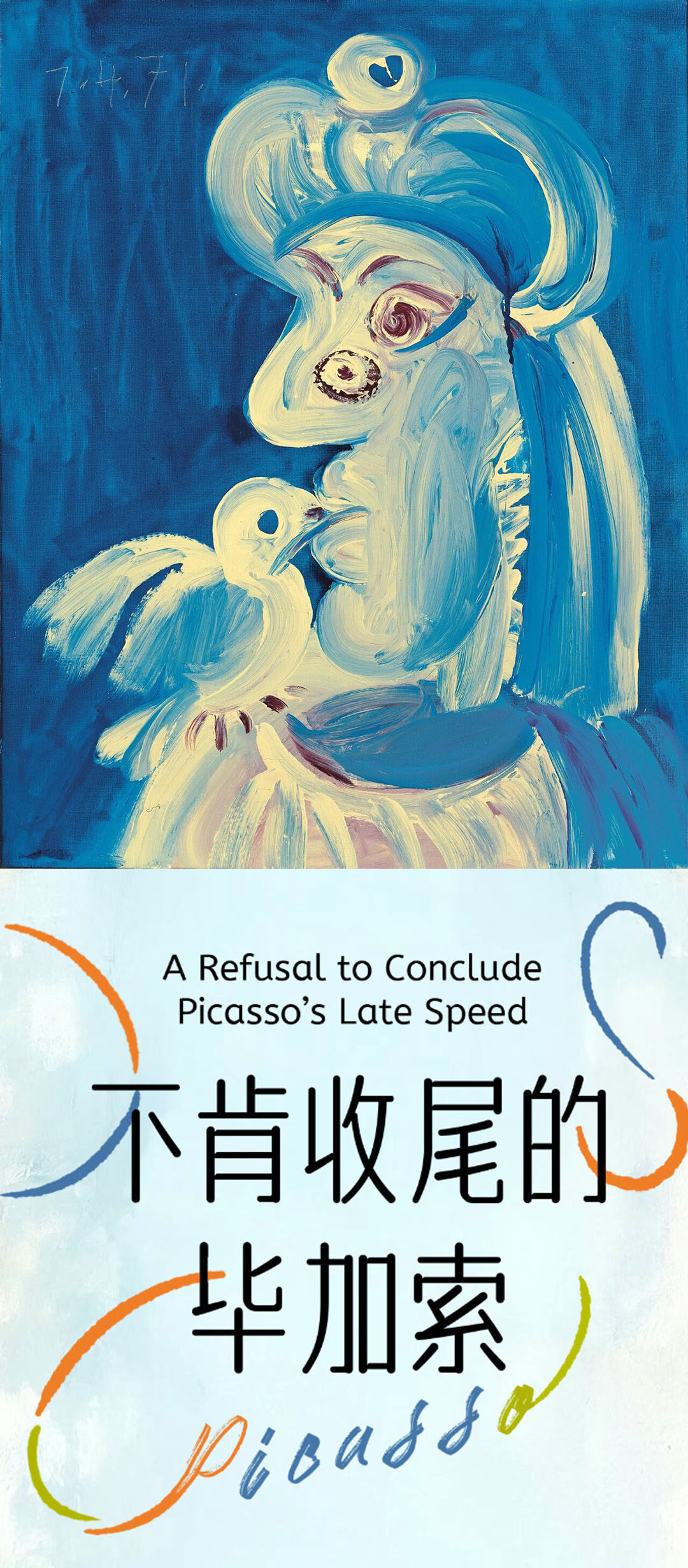
One of the founders of modern art, a pioneer of Cubism, and a central figure in Surrealism, Pablo Picasso (1881–1973) long ago outgrew the identity of an artist to become a symbol of twentieth-century cultural thought and visual revolution itself. A true watershed in the history of modern art, he absorbed and transformed one visual language after another — Impressionism, Symbolism, Neoclassicism, Surrealism — opening unprecedented paths through relentless experimentation. His work still reshapes how we understand image, emotion, and reality.
Consider Picasso as a walking timeline. At the Museum of Art Pudong, "Picasso Through the Eyes of Paul Smith" unspools more than seventy years of stylistic change into a sequence of navigable chapters, drawn from across the artist's career. Like a clearly plotted city map, the exhibition moves from the Blue Period into Cubism, circles back through Neoclassicism and Surrealism, and arrives at Picasso's final years. The route is explicit; the landmarks unmistakable.
The exhibit itself originates from the exhibition “Picasso Celebration: The Collection in a New Light” staged at the Musée Picasso Paris in 2023 took mark the fiftieth anniversary of the artist’s death. For its Shanghai presentation, the Musée Picasso Paris and the Museum of Art Pudong jointly selected 80 works, preserving the exhibition’s conceptual core while reconfiguring its display to respond to the Pudong museum’s open and distinctive architecture. Sir Paul Smith, a key figure in contemporary creative and fashion culture, serves as the exhibition’s artistic director and collaborator, offering a new interpretive pathway into Picasso’s work. Rejecting the conventional white cube, Smith builds an immersive environment out of color, pattern, stripes, and object — a rhythmic dialogue between artwork and space that draws viewers step by step into Picasso's universe, inviting the audience to feel its pulse.
Across the world, at this very moment, Moderna Museet in Stockholm offers something like the opposite entry point. "Late Picasso" runs like a countdown: ninety minutes that push viewers flush against the surface of the paintings, forcing a confrontation with the immediacy of the unfinished.
Set side by side, the tension is striking. One exhibition teaches us how to approach Picasso anew, lowering the threshold through design and display. The other protects his refusal to cooperate.
At Moderna Museet, the experience begins before you even enter the gallery. Tickets require a specific time slot, followed by a second instruction: stay for ninety minutes. It reads like an honest warning — a rhythm imposed on the act of looking. What awaits is an almost oppressive immediacy. The faster we move, the more we register Picasso's speed; the longer we linger, the more clearly those "casual" marks reveal themselves as repeated resistances to completion. Late Picasso is often misread as careless, repetitive, and uncontrolled. In the gallery, it registers first as a physical sensation: lines that feel freshly laid down, colors still bleeding outward, surfaces not yet cooled. Brushstrokes seem to have just left the skin; figures seem pulled straight off the canvas, still carrying body heat. Incomplete, yet intense. Unpolished, yet urgent. Moderna Museet names this condition "A Refusal to Conclude" — work that privileges urgency over resolution, that rejects polish and finality, turning the canvas into a threshold between art and life.
We're used to filing Picasso into a genius narrative, each period a neatly labeled chapter. Late Picasso does the opposite. It pulls us into the final decade of the artist's life — a state that resists archiving, and refuses to be summarized.
Entering Through Speed
The first task inside the gallery is simple: stop in front of a figure or a head. Watch the speed of the stroke — how a skeletal structure assembles itself in seconds, how eyes ignite, how a mouth gets dragged away in a single line. We begin to sense that the entry point into late Picasso may not be iconography but kinetics. He is not depicting a person so much as turning the act of seeing into an act itself.
This is why late Picasso so often unsettles viewers. It's as if politeness has been stripped away. There is no negotiation with the viewer, no patient buildup — he throws the present moment straight at us. Curator Jo Widoff notes that these works care more about urgency than completeness; in the gallery, that becomes tangible. What we see is not a polished "final version" but a sketch still warm to the touch, blown up into a painting.
Again and again, we meet images that carry almost no information yet land with enormous force — like a message compressed to its barest signal, still transmitting at full emotional bandwidth. Picasso seems to be encoding the visual world into short, rapidly transmissible codes. One might call it a pre-digital low-bitrate aesthetic: minimal data, maximal charge.
Naturally, as these strokes pass before us, Picasso’s late years surface. In 1961, Picasso bought Notre-Dame-de-Vie in Mougins, where he would live and work for the rest of his life. In 1965, at eighty-four, he underwent stomach surgery and recuperated in the South of France. Recovery didn't slow him; it instead pushed him toward an even more concentrated, solitary way of working. The Musée Picasso Paris has described this period as marked by "the frenzy and freedom of the final years."
Many of the late heads read as byproducts of speed, but they can just as easily be read as acts of will: in the face of aging and time, painting stops being a passive record and becomes active resistance — life compressed onto canvas through faster, more direct means.
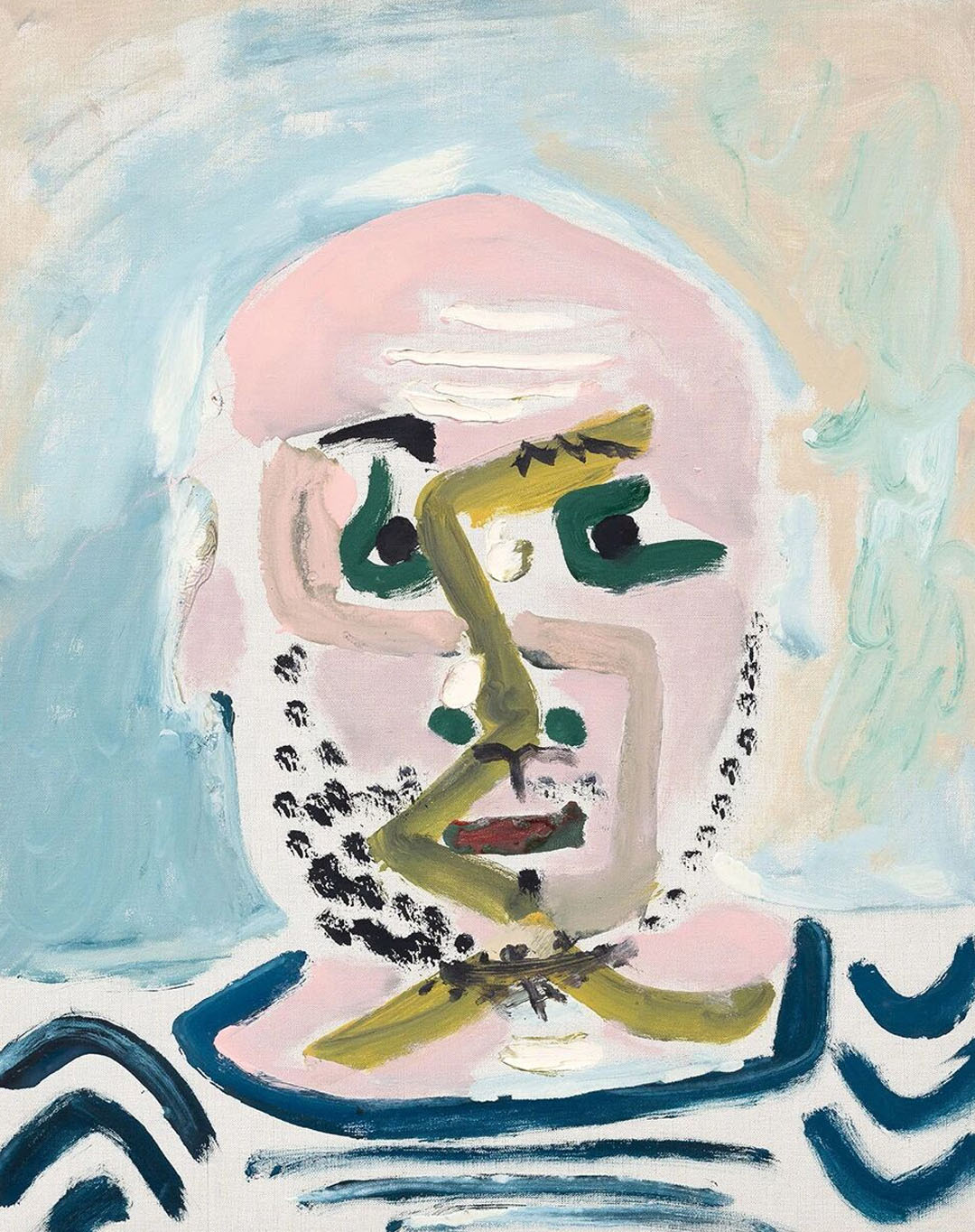
"Buste d'homme", May 1965, a large-scale bust portrait featuring a pink face set against a light blue background
Repetition as Method
If speed defines the first section, repetition defines the second — similar poses, recurring figures, near-homologous compositions. Much of the fatigue directed at late Picasso stems from this repetition, as if he were simply copying himself. But within the frame of Late Picasso / Code of Painting, repetition isn't depletion, it is instead training. He returns to a single subject again and again, pushing a visual language to its limits.
Scholarship often links the Musketeer motif to Picasso's post-surgery recovery. In an article on Mousquetaire et nu assis (1967), Christie's notes that the musketeer figures emerged in late 1966 and quickly grew into a major body of work. During his recovery at Notre-Dame-de-Vie, Picasso read Shakespeare, Balzac, Dickens, and Dumas. The story itself reads like a late painting: an aging man in a villa in the South of France, restoring his body while pouring his intellectual fire into literature and historical drama — letting musketeers, nudes, parody, desire, classicism, and smeared paint collide on canvas, extending a dialogue with art history through role-play.
Here, repetition becomes method. The same subject isn't used to tell more stories — it's used to change the encoding: shorter, sharper, more direct. We start to understand that the real protagonist of late Picasso isn't the theme but painterly procedure itself — painting as an ongoing self-experiment.
With ten-odd minutes left, the best move is to return to the two heads where we first stopped.
A second viewing feels like switching eyes: we suddenly catch the shadow of classical structure inside what looked like offhand distortion, and glimpse a confident command of body, composition, and painting's own historical schemas inside what looked like childlike simplification.
At this juncture, "A Refusal to Conclude” stops being an abstract slogan and becomes a concrete technical choice: Picasso could have pushed the image toward completeness, toward resolution, toward something more like a "finished work" — but he chooses to stop at the threshold instead, turning incompletion into a stance.
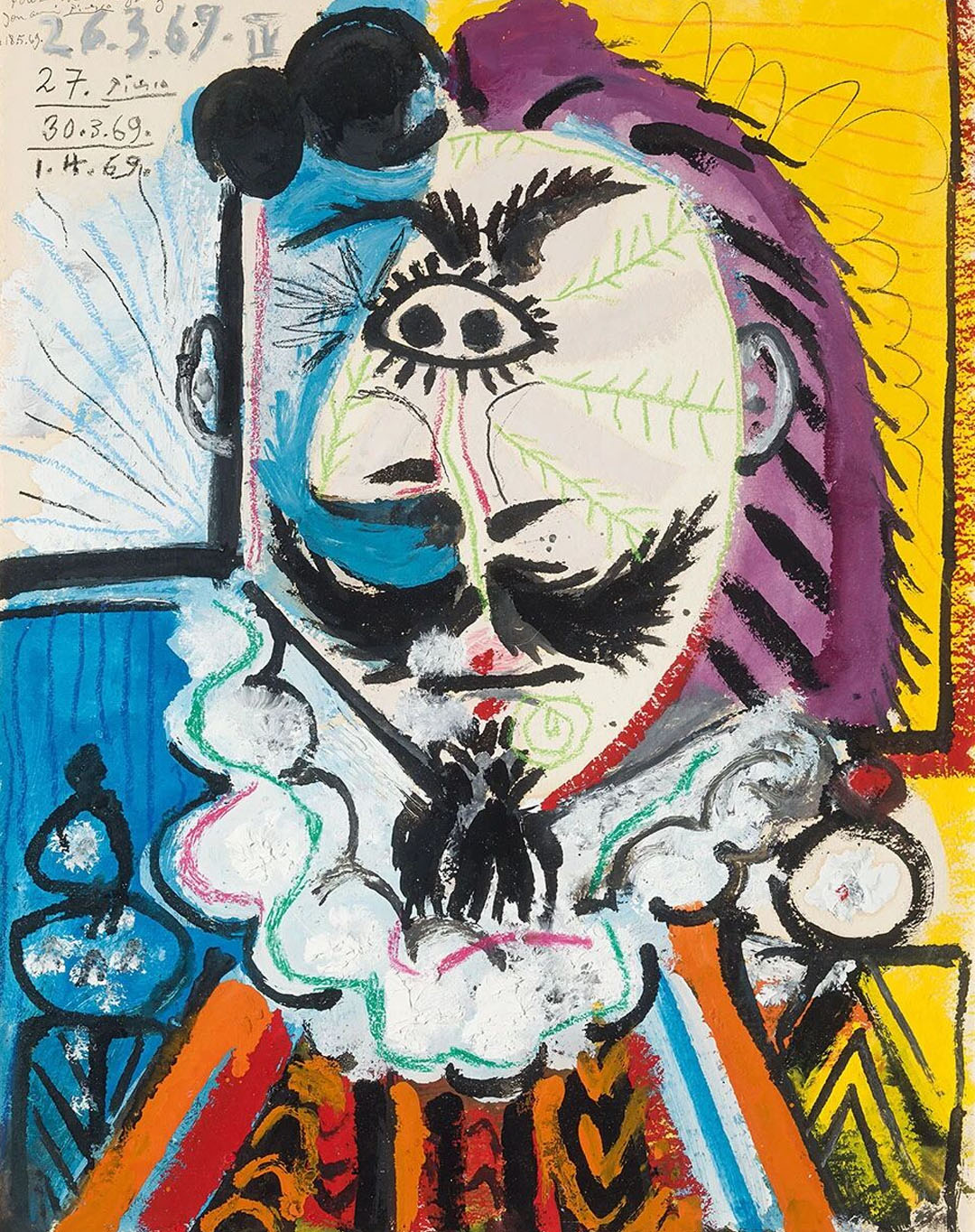
"Tête d’Homme", May 1969, a "fictional portrait" imbued with a sense of stage presence
Thus, when we move from the white cubes of the Nordics to Shanghai's "designed intimacy," we become more attuned to the contrast: the spatial language Paul Smith brought to the Shanghai stop — color, pattern, a navigation system built from stripes — turns viewing into something with signposts, a space you can "enter." Stockholm's cold light and bare walls, by contrast, strip away signposts, rendering the excess of the late brushwork surface direct, bare and unmediated.
The Nordic White Cube: Restrained Light, Amplifying an Excess of Brushwork
What's interesting about "Late Picasso" is that it's a Nordic touring exhibition, and the project itself can almost be treated as its own protagonist. Trondheim's PoMo, in Norway, frames it as "Code of Painting," foregrounding the encoding and method of Picasso's late work; Stockholm's Moderna foregrounds "A Refusal to Conclude"; and Aalborg's Kunsten, in Denmark, builds a narrative of collaboration and reassessment, casting a period long dismissed as neglect as instead pioneering, with a lasting pull on the art that followed. The works themselves, of course, are never fixed. The same body of work gets renamed, reorganized, retold from city to city — what we're watching is not only Picasso, but curating itself at work.
This points to a distinctly contemporary understanding: exhibitions don't transport meaning — they translate it. Touring isn't replication but repeated re-encoding across contexts. The same works pick up new subtitles, and subtitles change how we see.
Nordic galleries are often imagined as restrained and cool; late Picasso is dense, overheated, excessive. Their encounter doesn't cancel either quality out, it, however, amplifies both. White walls and cold light strip away romanticism. What remains isn't the elegance of a genius in old age, but a body thrown into painting — gesture, hesitation, impulse, repetition, loss of control, all laid bare.
The white cube becomes an optical device, sharpening the roughness of late Picasso and keeping "refusal to conclude" from being mistaken for sloppiness. Style alone can't smooth this over — the paintings insist on being met as close-range physical events.
Once "Late Picasso" teaches us to read incompletion as a stance, returning to Shanghai gives us a more tender way of seeing: noticing which design choices bring us closer to the work, and which ones quietly finish it off on the work's behalf without our even noticing. And we'd have to admit, many viewers indeed need a friendlier path before they're willing to step into Picasso's complexity at all.
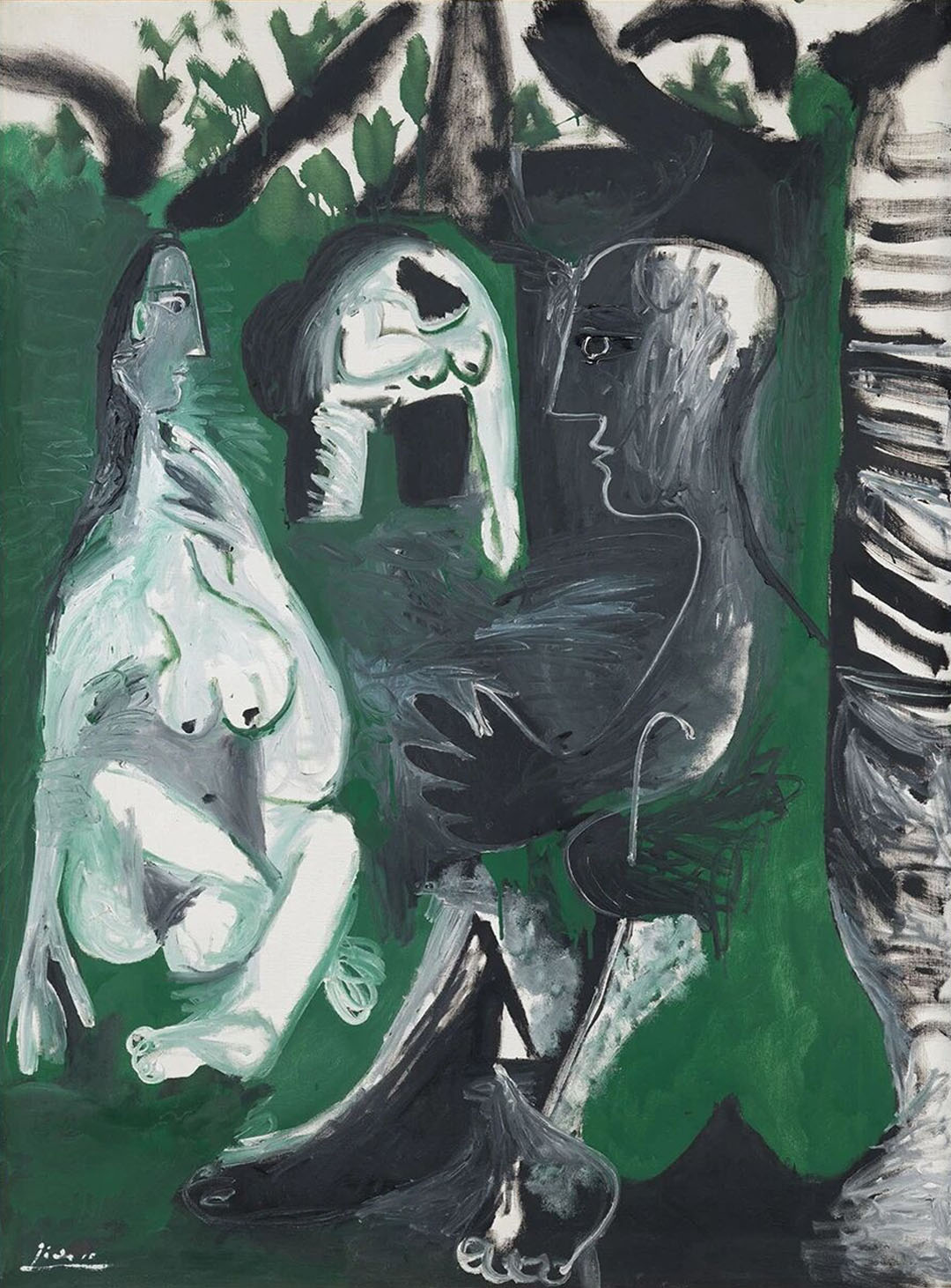
"Breakfast on the Green Grass", Le déjeuner sur l’herbe, July 1961
Under the Shadow of Controversy: How Picasso’s Much-Maligned Late Period Is Being Reread
Any discussion of late Picasso must confront controversy. The period was once dismissed as uncontrolled, vulgar, and indulgent. The collector and critic Douglas Cooper used scathing language to write these works off, while John Berger, in “The Success and Failure of Picasso” (1965), delivered a sharp critique of Picasso's late work and the success narrative built around it.
These debates are what make “Late Picasso” a true contemporary project. It isn't simply arguing that the late work is "also great." Instead, it reminds us that art-historical judgment is always shift, that scales of viewing likewise change, and that even the value placed on "closure" can be overturned. Kunsten notes explicitly that this period was long ignored after Picasso's death, only to be reassessed and recognized for its influence much later.
There's an anecdote here that carries an almost fated quality: Moderna Museet's collection guide notes that on May 23, 1973 — six weeks after Picasso's death — the Palais des Papes in Avignon opened “Pablo Picasso 1970–1972: 201 Paintings”, an exhibition Picasso himself had planned as his last major show. He selected the works personally in the final months of his life, and the catalogue was finished shortly before his death on April 8, 1973.
A man who refused to bring anything to closure still arranged, for himself, one last way of being seen.
Leaving the exhibition, we may find we haven't acquired a conclusion about late Picasso. Instead, we gain something more valuable: the ability to treat incompletion as a position rather than a flaw, and to understand touring exhibitions as mechanisms of translation— meaning generated in motion, not carried intact from city to city.
Late Picasso may not please everyone. If early and middle Picasso offered art history many answers, the late work throws questions back at us instead: Why do we crave conclusions? Can we possibly accept an image suspended mid-air? Can we ever treat the unfinished as a stance?
Today, we're thoroughly schooled in completion; it is of high definition, retouching, version control, portfolio logic, and publishable states. Art increasingly resembles a deliverable product. Late Picasso seems to say: I do not deliver. The keyword of the late period, then, isn't freedom but something sharper: non-cooperation. Non-cooperation with aesthetic order, with elegance, with the demand for a coherent conclusion. This is why the late work was misread for so long. Measured against the standard of completion, it looks regressive. Measured against the standard of presence, it becomes frighteningly modern.
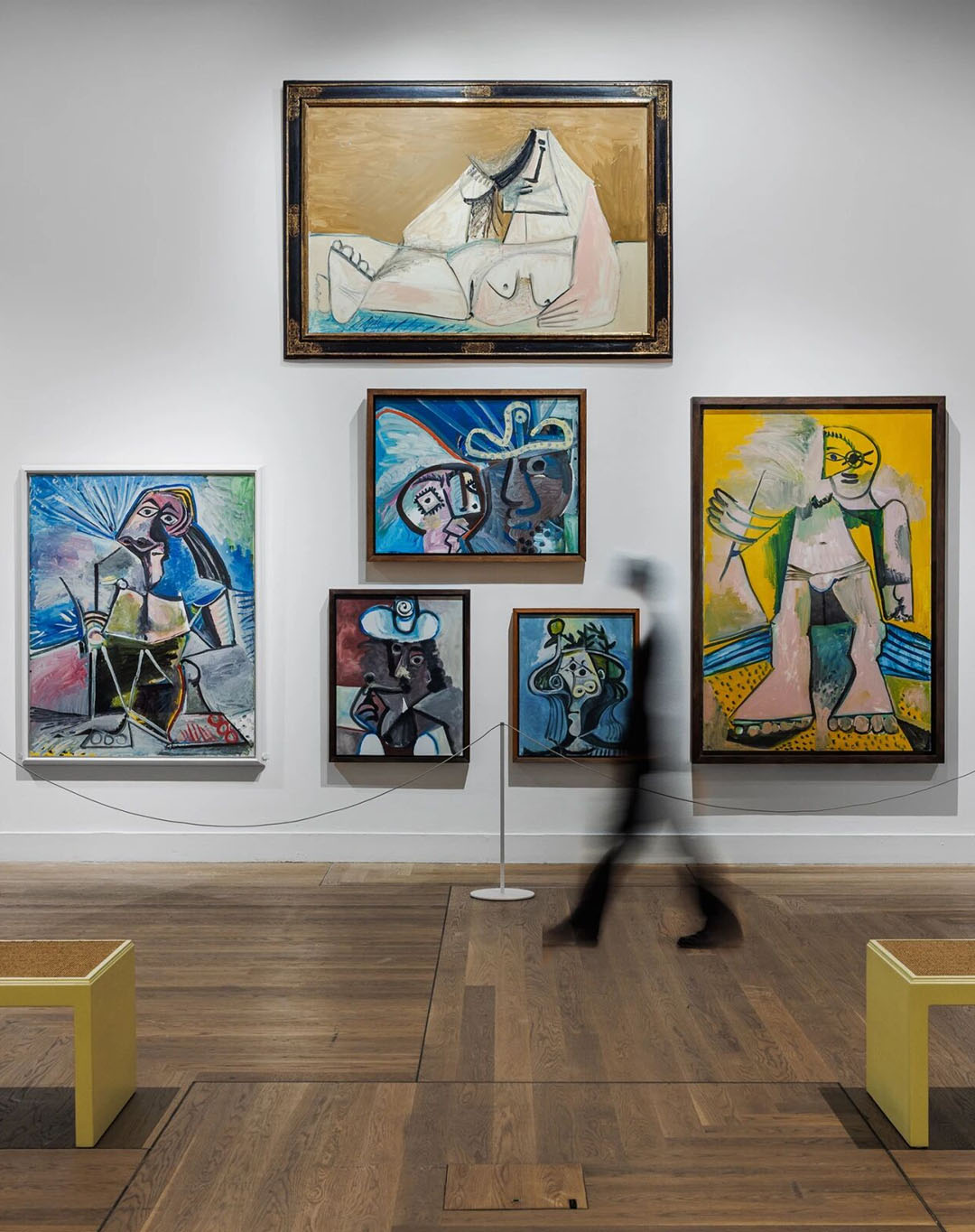
The scene of the "Late Picasso" exhibition in Stockholm, 2026 © Moderna Museet

Producer: Tiffany Liu
Editor: Tiffany Liu
Designer: Yuki
Images: Courtesy of Moderna Museet, Stockholm, Pudong Art Museum, Shanghai, the artist, and the internet



