Those "paper people" that seem to have leapt straight from a child's sketchbook have become one of the contemporary icons spanning Europe and Asia, crossing linguistic boundaries with ease. Their creator, French artist Jean Jullien, often dubbed the "father of the paper people," casts deceptively naïve line drawings like a wide net, one that catches the humor, warmth, and quiet absurdity threaded through modern life.
From the viral "Peace for Paris" symbol that swept across social media, to his oversized paper figures staging playful invasions of public space, and now to "JUJU's Castle" at Shanghai's Nanshige Art Center this summer, Jullien has circled a single, persistent question throughout his practice: how might art dismantle the heaviness of reality and build, in its place, a castle for the mind to rest in? Drawing on childhood imagination and the roles we inhabit within family life, this fantastical castle serves not only as a playground for children but as an open invitation to weary adults — an invitation to put on a mask, shed the weight of social convention, and let art do its quiet, healing work. Jullien’s first solo exhibition in China brings together more than eighty recent paintings and installations. In the venue's outdoor plaza, a ten-meter orange pterosaur of the artist's own making faces off against a sword-wielding warrior in epic confrontation, their wings and armor catching the sunlight with a sense of fantasy and spectacle. In an exclusive interview with Oui Art, it becomes clear that Jullien's practice amounts, at its core, to an ongoing experiment in freedom, connection, and inner liberation.
01 The Defection of the Flat Surface: From Design Rules to a Playground of Lines
Jullien's starting point was not some rarefied artistic ivory tower, but a traditional graphic design education in a small French town. That early training gave him a solid visual foundation and, at the same time, planted the seeds of his later creative departure. His years at Central Saint Martins in London, which he describes as a "gentle rebellion," marked the turning point: there, rigid design rules ceased to be sacred law and became instead raw material, meant to be dismantled and recombined.
He threw himself into everything — advertising photography, experimental film, silkscreen printing, illustration. What mattered was never technical mastery, but an uninhibited urge toward expression. His work refused to stay confined within fine art, instead fusing a range of cultural and creative disciplines into something harder to categorize.
It was within this atmosphere of free collision that his signature "paper people" began to take shape — born initially from an obsession with cut-out figures, used to construct small theatrical scenes. Defined by minimal black lines, exaggerated gestures, and flattened perspective, the style quickly found its way into major publications like The New Yorker, Le Monde, and The Guardian, offering a commentary on modern life and human relationships that was gentle in tone but sharp in observation. French media have described it as a form of "gentle critique." Perhaps the most important lesson Saint Martins taught him was this: art is not a binary choice, the task is first to listen for one's inner voice and trust that the medium will find its own appropriate form. That insistence on expressive freedom and on fluidity between media became the foundation for everything cross-disciplinary he would go on to explore.
02 The Self-Growth of Paper Souls: From Fragile Medium to Steel Giants
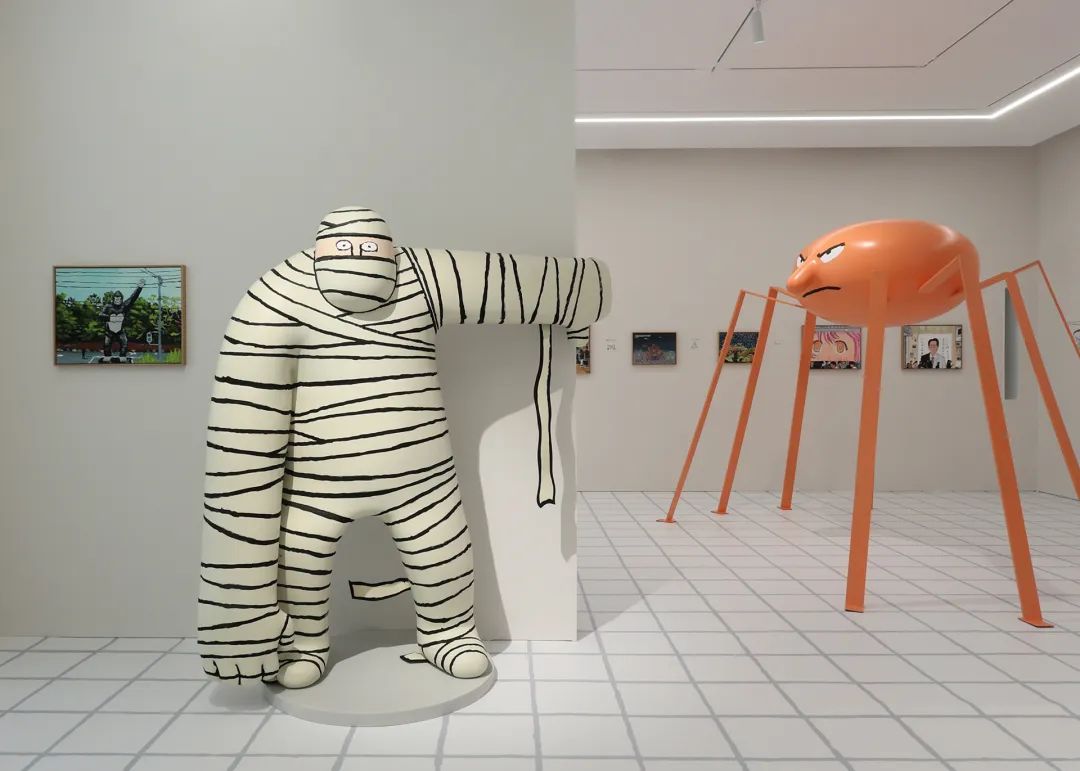
Jullien's "paper people" refuse to stay confined to the two-dimensional page. They've undergone something closer to growth, even mutation — a slow evolution rooted in his ongoing exploration of fragility and presence.
In conversation with Oui Art, he offered a striking piece of creative philosophy: even his most casual sketches, the ones tossed into the trash, seem to come back to life, as though they'd secretly cut out companions for themselves while no one was looking. This impulse — to grant lines a kind of independent life — is what eventually drove him to scale the figures up, dramatically.
Commissioned for a public garden in France, his fragile paper figures grew into steel giants standing three to four meters tall. More poetically still, the rusted welding seams along their surfaces came to unexpectedly echo the folds of paper. In this transformation of material, fragility didn't disappear — it simply found a new form of resilience.
These monumental figures intrude on real space with a kind of deliberate, almost forceful "inappropriateness." As Jullien explains it, the exaggerated disruption of scale overturns everyday perception, landing its impact through humor — a sense of "inappropriateness" produced on purpose, meant to unsettle rigid social orders and systems of authority.
This practice, in his own words, reassembles the human world using the logic of paper. The shift from two-dimensional sketch to three-dimensional, narrative-driven public installation marks a genuine leap in his artistic language — a move from social observation toward something closer to poetic intervention in space.
03 Absurd yet Brave: A Playground for the Adult Mind
In recent years, Jullien's practice has turned increasingly toward building participatory, emotionally restorative public spaces. His influences move fluidly between Eastern and Western visual languages — from Japanese manga like "Saint Seiya," "Dragon Ball," and "City Hunter," to the mischievous worlds of French picture-book master Tomi Ungerer. This fusion runs throughout his exhibitions, surfacing in travel-inspired curiosity sketches made in Japan and in medieval monsters woven into the show's narrative fabric alike.
The emotional core of "JUJU's Castle" is rooted deeply in Jullien's childhood memories and the archetypal roles of family. Here, art breaks free entirely from frame and screen, evolving instead into an immersive playground built from large-scale sculpture, interactive installation, mural, and costume. His intent undergoes a decisive shift: he no longer wants audiences to merely observe the work, but to enter it — to become part of the castle itself through role-play and physical interaction, a return to childhood staged through the body rather than the eye.
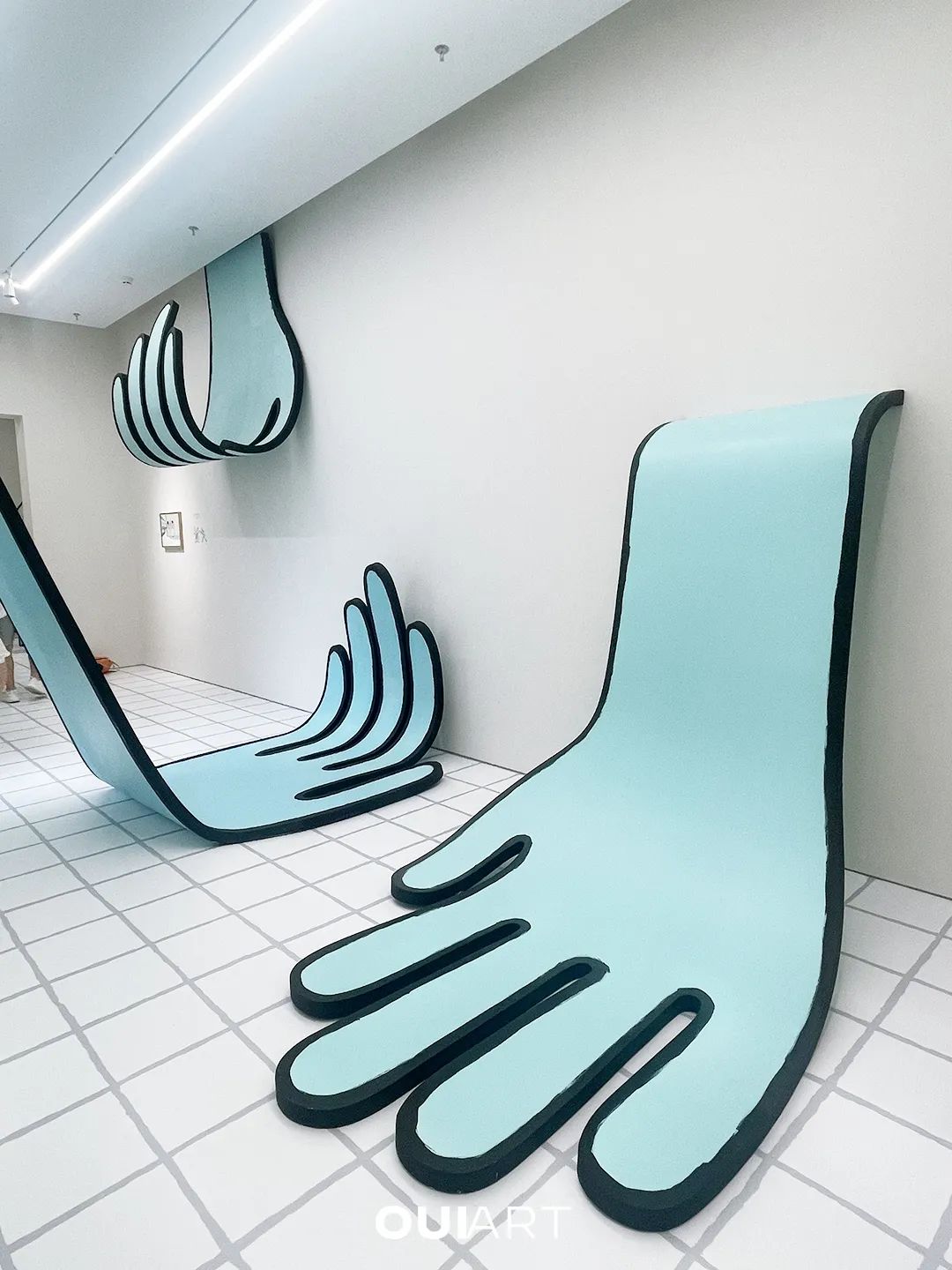
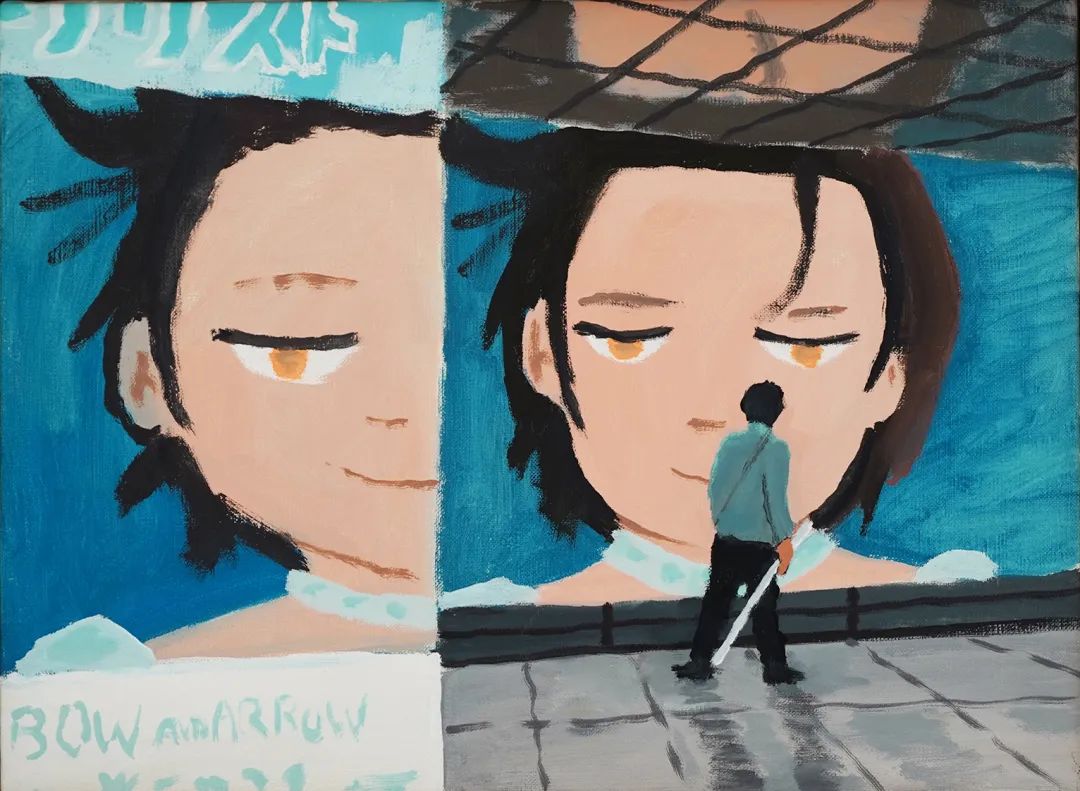
As Jullien frames it, this isn't meant to feel like a conventional exhibition so much as a role-playing game. A sushi-train-like vehicle carries visitors toward a fortress of imagination — an opening scene inspired, fittingly, by his son's favorite toy train. From there, visitors choose among four adventure roles drawn from family archetypes: elf, warrior, mage, knight. Along the floor and walls of a white corridor, oversized blue hands emerge again and again, embodying the suffocating sensation of being pulled at by modern pressure and reality. A solitary archer, echoed in the surrounding wall drawings, carries a quieter message: that when pressure closes in, one should draw back like a bow — pause, observe, then act.
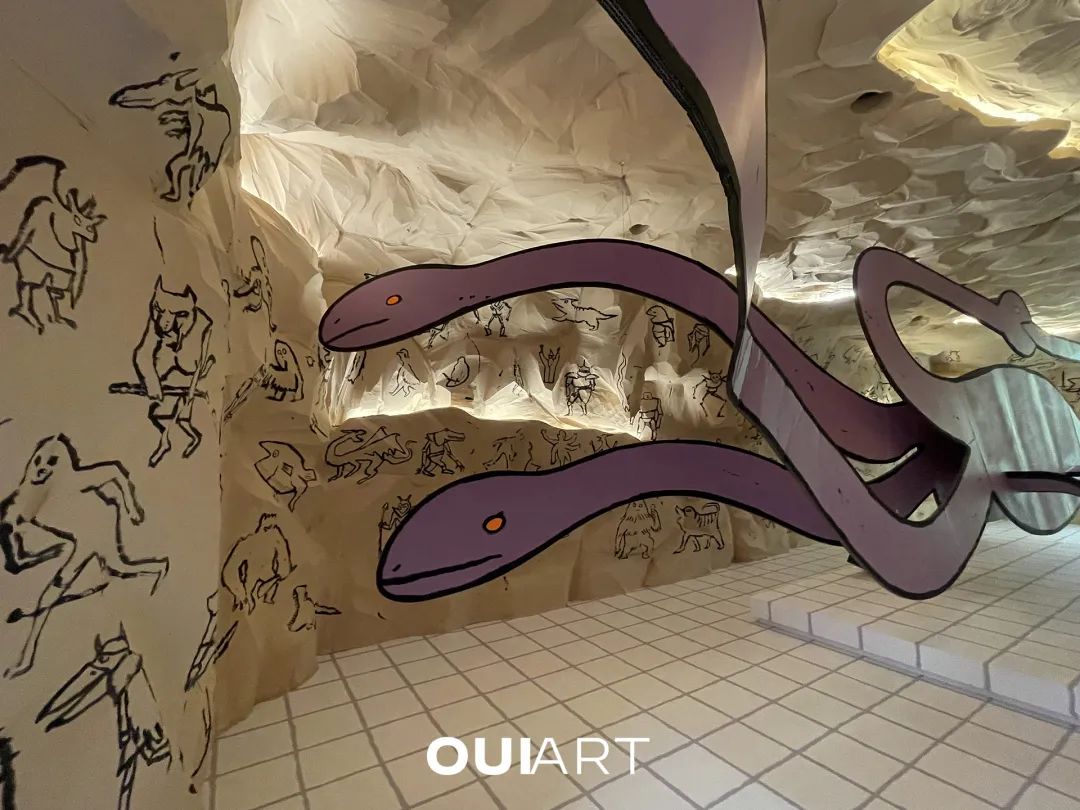
A dungeon populated with roaming monsters suggests that life resists easy division into black and white; calm is so often followed by unexpected risk. In the cave of the Hydra, the walls are dense with drawings of creatures and battle. This cyclical, regenerative visual language points toward a deeper conviction: that wisdom lies not in eliminating our problems, but in learning to live alongside them.
Speaking with Oui Art, Jullien stressed how urgent it feels, in the world as it now stands, to build spaces where adults are permitted to play and to heal. This translation of childhood memory into a more universal emotional language — art conceived as a field of healing — answers to something like a shared psychological hunger running through contemporary life.
The Shanghai staging of "JUJU's Castle" represents not only the fullest realization yet of Jullien's artistic vision, but a new height in his ambition to build shared emotional space through art, and to offer, through it, something like a universal capacity for healing. Within this world assembled from his own lines and colors, Oui Art sat down with the "father of the paper people" to talk about the forces driving his creativity, his evolving relationship to medium, and his complicated stance toward the digital age.
Oui Art Dialogue Jean Jullien
Q:
I saw your giant paper people installation at Le Bon Marché in Paris. Could you talk about the inspiration and development process behind it, how did it evolve from the tiny demo to the final work?”
A:
The idea is to challenge perception — to take something as minimal as the cut-out characters we all made as kids and blow it up in scale until it invades the realm of reality. That brutal confrontation between what you expect and what you actually see, at that scale, is what makes it challenging and engaging. I enjoy creating something that feels 'inadequate' in its surroundings, because that's exactly what challenges the fixed, official order of everyday life.
Q:
What is the core of the paper man?
A:
The paper people started when I was at Saint Martins — cutting out paper characters and arranging them into small, theatrical scenes. Years later, a public garden in France commissioned park sculpture, so I revisited those characters in steel, three or four meters tall. The result is wonderfully imperfect — the rust and grime on the welds actually recreates the creases of paper.
These enlarged silhouettes are really sketches I once threw in the bin, come to life. Lonely, they secretly cut out companions for themselves. Last year in Bordeaux [transcript mishears this as "bowl"], they pressed against shop windows watching the street — reassembling the human world using paper's own logic. Their crooked, awkward way of existing is somehow more unsettling than tidy reality."
Q:
The “Peace for Paris” symbol during the pandemic era made you an overnight social media sensation. What exactly happened at that time?
A:
At that point, I already had a few hundred loyal followers, so it wasn't an accident — there was already an audience. I've always used my work to react to what's happening in the world; it was a hyper-accelerated practice, still pretty new for a lot of people on social media at the time. I just reacted to something that affected me, and through the mechanics of social media — something almost therapeutic and viral at once — it simply traveled. I think people found it meaningful, or found it captured something youthful about that moment, and shared it. That was it.
Q:
How did your drawing and installation style come to be formed?
A:
There's always been a playfulness at the core of what I do. I trained in graphic design in a small town in France, which gave me a rigorous foundation — Saint Martins- and moving to London felt like a gentle rebellion against that. It wasn't about executing a brief for a client; it was about being as creative as possible. That first year we were like feral kids in a lab, trying everything — video, photography, advertising, illustration, screen printing, film. What mattered wasn't mastering technique, it was the sheer, unguarded impulse to express something. Bouncing off other creators, I learned the bigger lesson: art was never either/or. Listen to your own voice first — the medium follows. That still feeds everything I make.
My work has always played with a contradictory aesthetic — I want the maturity of adult painting, but I'm drawn to lines that feel almost naive. There's something timeless in that apparent clumsiness, as if it could leap off the canvas into a picture book on a modern street corner. That simplicity is a gentle rebellion against classical French painting, which chased precise light, perspective, and realism — my lines are weaving a passage out of reality instead.
Q:
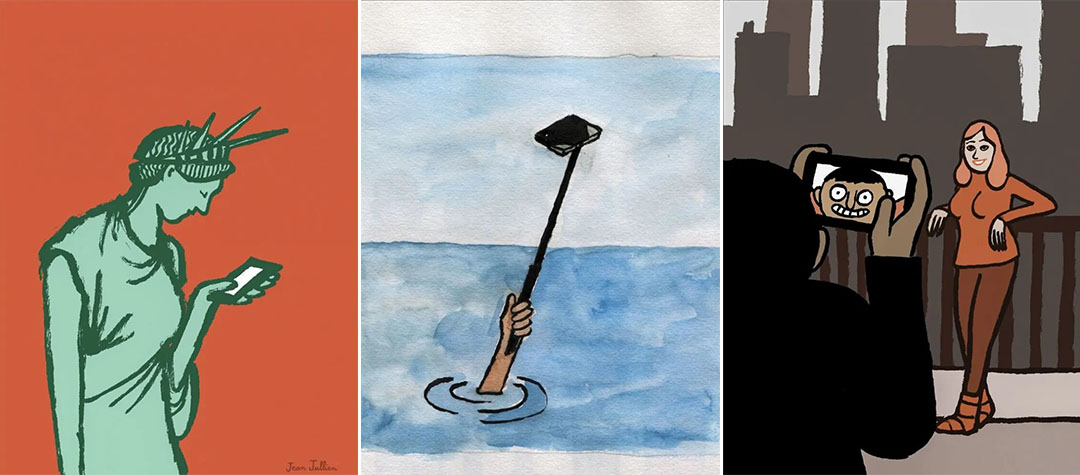
One of the series I remember most vividly is your “SELFIE” series of drawings—"Mirror, Mirror…”, “Statue of Liberty”, “Never Alone”, and others. Is this series the result of social observation? As someone who became a social media figure, what is your attitude toward social media?
A:
Your question touches a real contradiction. Social media started out, for me, as an incredibly democratic tool — it let my work reach an audience directly, which felt revolutionary. But like any medium, as it ages — radio, television — you eventually see its downsides. Today, we can't ignore the addictiveness or the darker side of tech giants shaping what we see, even as we keep enjoying and benefiting from it.
It's never black or white — it's as complicated as most things in life. I hate the addiction I have to it, and I love that it lets me share my work and connect with people everywhere. That tension is probably a paradox every artist working today has to live with."
Q:
We have to talk about the “large-scale work” outside the exhibition space this time—THE DUEL!
A:
This piece Eric sent felt like a key that opened a drawer deep in my memory — a drawing I made at five, a caveman battling a dinosaur, which my parents kept. Looking at it now, I think my whole artistic instinct was already there in those wobbly lines. It was never really about getting the dinosaur's claws right, or the caveman's tools historically accurate — it's about the reckless courage of a kid holding up a stick against the dark. Everything I've made since is really the same primal scene, redrawn with more sophisticated technique
Q:
Among your many drawings, there is a mask collection. Who is the person behind the mask?
A:
Honestly, I could give you a clever-sounding answer, or just tell you the truth... The truth is, my son and I both love Japanese pop culture. But on a deeper level, masks matter here because everyone in reality already lives behind some kind of filter — Roger's mask becomes an honest metaphor for that. I want people to see life through Roger's perspective and recognize that a mask is just another way of inventing an identity. It fits the show's narrative perfectly.
Q:
Are these works placed in front of buildings, on streets, in parks, and on beaches inspired by your travels and what you’ve seen along the way?
A:
Since January, we've been traveling around Japan constantly, exploring as much as possible. I'm lucky my work runs on inspiration as fuel. Along the way, the structure of the show became clear — like writing a book, where each chapter, or room, needs its own material. So I went out and gathered visual references to give shape to what I wanted to say. Since the show is about finding beauty, or a positive response, within the negative side of reality, nature became one of my most important refuges.
Q:
I noticed the theme of the billboards in this exhibition—the recurring giant faces. Why do you choose to keep exploring this visual motif?
A:
Visually, it's thrilling to bring that much drawing into painting. I've always wanted to blur painting's coded language by bringing drawing into it — through paint, through printed imagery — and that blurring became part of the show's story. Same idea in the painting with the shipping container and the cappuccino cup: putting giant heads into everyday scenes speaks to the show's theme of retelling reality. I'm trying to find fantasy in the everyday — a convenience-store window, a port crane — and these giants are the vehicle for that.
Q:
The piece on the exhibition poster is called “KV”. Could you explain it to us?”
A:
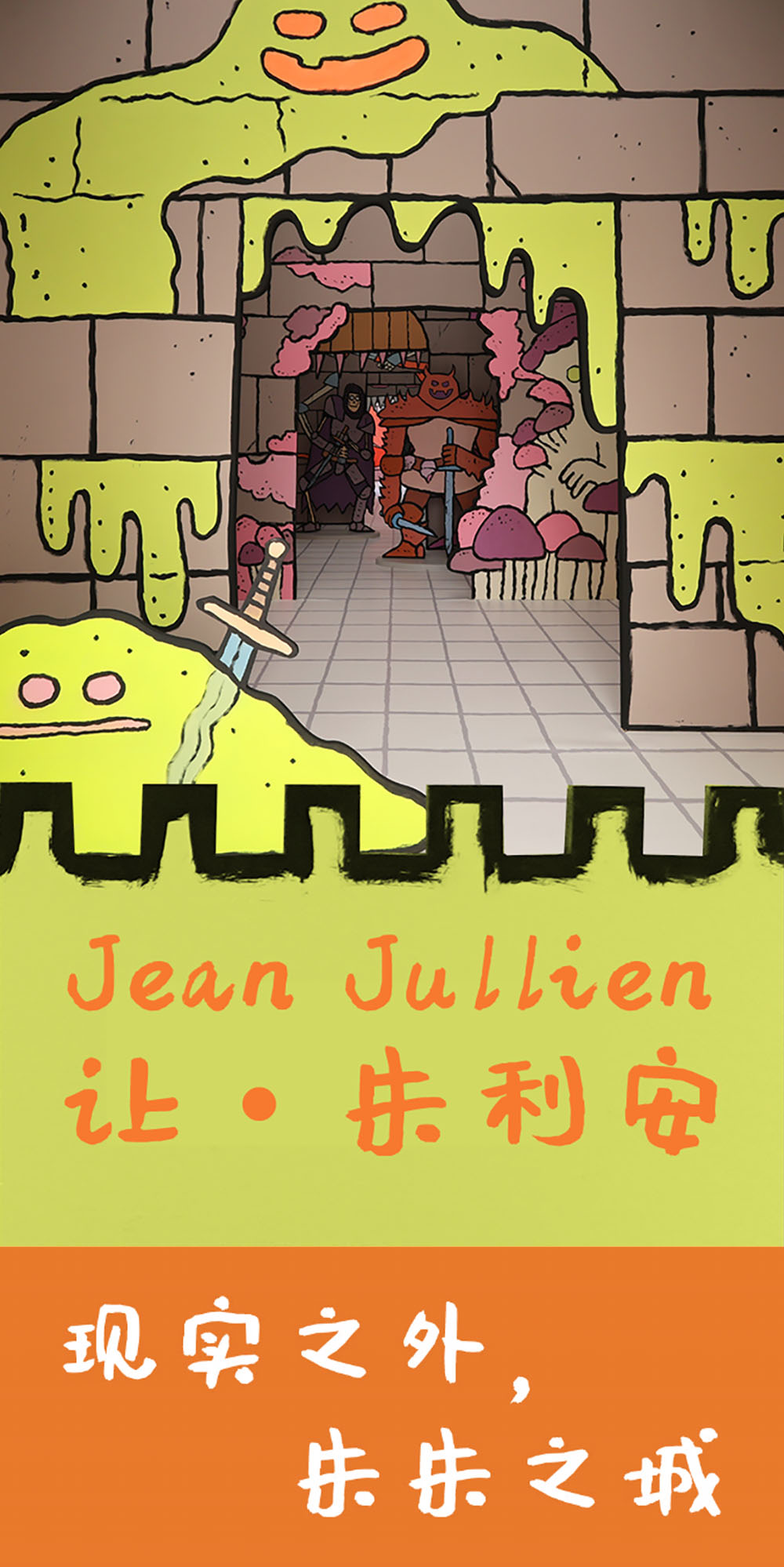
This key visual comes from my family life. The show began when my younger son Hugo and I moved to Tokyo, into a completely empty house. We had to buy furniture, and instead of throwing away the cardboard boxes, we started building little houses and costumes out of them. Refusing to discard things became my whole working method — everything in this show is the result of that everyday playfulness with discarded materials. It fit the exhibition's theme perfectly.
Q:
In the castle, the four characters—GIGI, JUJU, LULU, and EGGO—on whom are they based?
A:
This set of characters builds an intimate little universe — LULU is my son, GIGI is my wife Sarah, JUJU is a mix of me, and EGGO comes from my uncle's nickname. I've always used friends and family as the basis for characters. In Tokyo, we were a self-sufficient little unit — there are always other people around, but the core is just the four of us: parents and children, the whole creative foundation.
Q:
When you were a 10-year-old boy, what kind of “superpower” did you want to have? In Chinese culture, we say “at forty one is no longer confused.” As someone born in 1983, what is the “superpower” you most desire now?
A:
Forty definitely hasn't brought much clarity... As a kid, the choice would've been simple — flying, the most basic fantasy. Something unique, a completely different way of experiencing the world. Now... maybe controlling space and time? An adult's fantasy has to carry some philosophical weight.
Q:
Have the pandemic in the past few years, the shadow of ongoing wars, and the recent development of AI technology influenced the way you think about these imaginative characters?
A:
I feel it deeply — we're in an age of hypermedia, and between social media, traditional media, and society as a whole, there's a constant over-amplification of anxiety. As an artist and as a father, I have to respond to that. What our generation lost is childhood's natural innocence. I'm trying to reconstruct that untouched state in my work — why were we less exposed as children? Because the line between reality and fiction wasn't so clearly drawn, and you didn't have to be 'reasonable' all the time. Now I just want to rebuild that fortress against the outside noise.
On escapism — people criticize kids for escaping reality through video games, but isn't that escape itself a response to reality? Mine is different: an active rebellion. Refusing to be buried under an avalanche of negativity, stepping back to repair yourself, then returning in better shape. Not weakness — a beautiful survival mechanism.
Producer: Tiffany Liu
Interview,Editor: Tiffany Liu
Partial shooting:Yoko Liu
Designer: Nina
Images: From NANZUKA ARTINSTITUTE, Oui Art on-site photography, and the internet