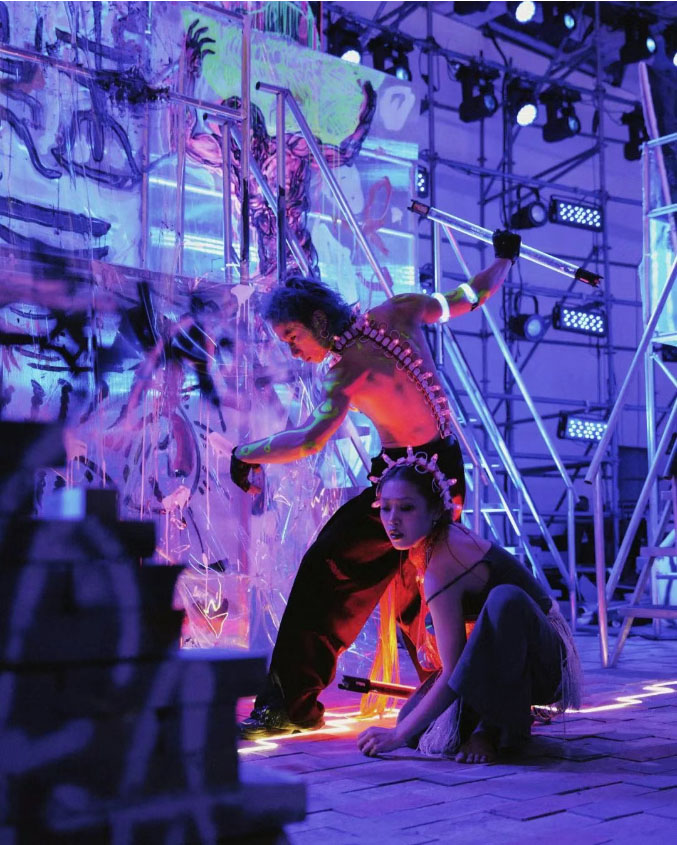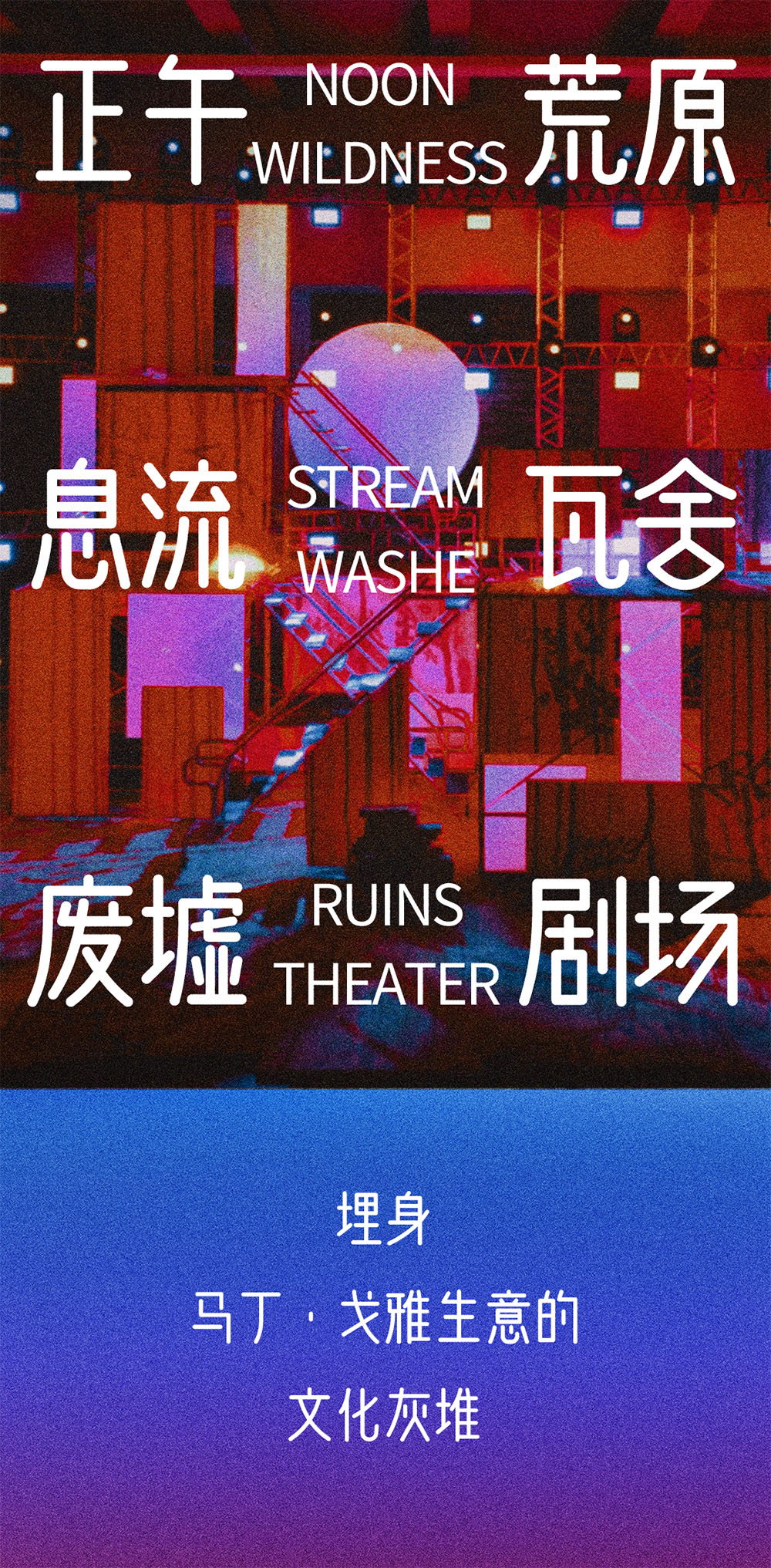
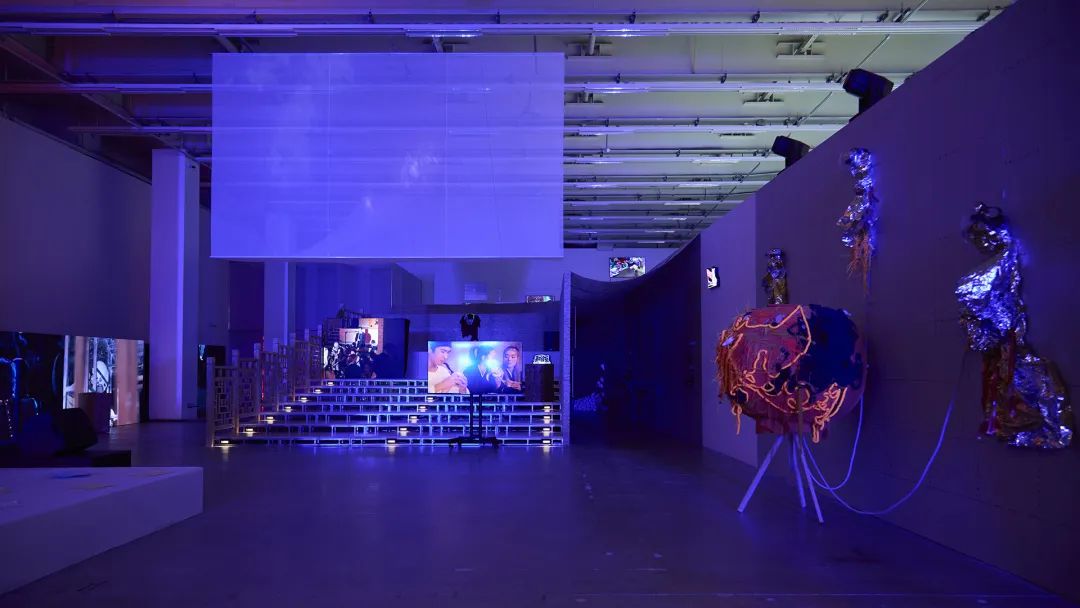
"Objects the world discards, I do not abandon; I preserve them in image, and let them dissolve slowly into the passage of days and months." Living in thirteenth-century Huzhou, the scholar-official Qian Xuan once found himself lingering over the scraps left behind after a meal — shrimp shells, half-eaten fruit, withered petals, a dead butterfly, ants, feathers. Out of that contemplation came "Heaps of Brocade and Ash," a work now widely regarded as the origin of “jinhuizui”(brocade-ash heap), an artistic form that transmutes discarded fragments into visual composition. On the first floor of the Power Station of Art in Shanghai, a contemporary “jinhuizui” is taking shape. The residue and traces of a live collective action, performed by 150 artists and cultural practitioners, form the foundation of a theatrical landscape titled "Noon, Wildness, Stream, Washe, Ruins, Theatre."
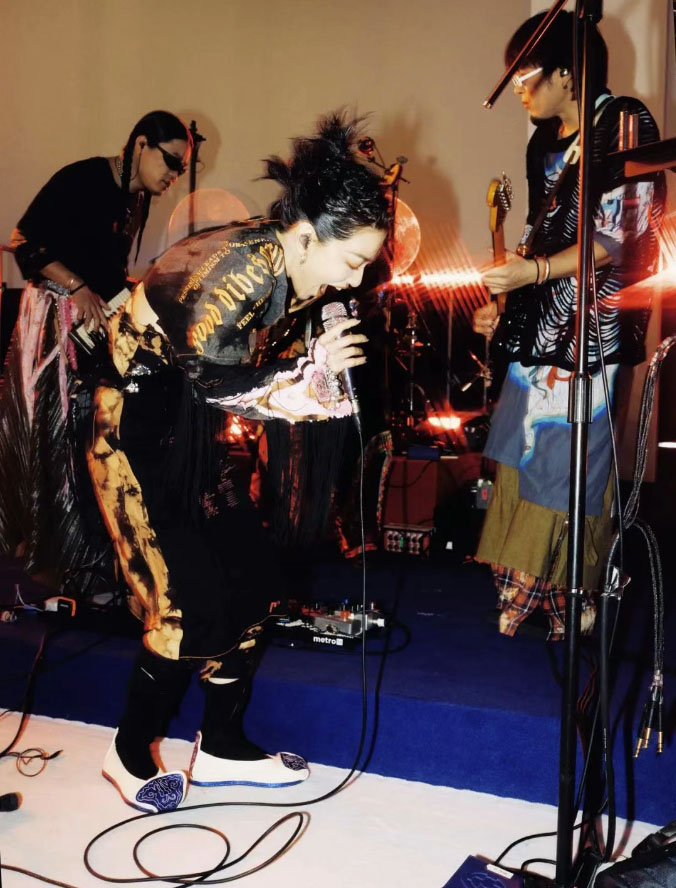
Curated by the Hangzhou-based collective Martin Goya Business — Da Mian, Cheng Ran, Tao Peiheng, and Chen Xunchao — the project is the winning proposal from the third season of "the Next Cultural Producer," a program on the theme of "Theatre" jointly initiated by the Power Station of Art and the CHANEL Culture Fund. "Noon, Wildness, Stream, Washe, Ruins, Theatre" sets out to dissolve the conventional boundaries separating theatre, performance, and exhibition. The project opened officially on July 11, 2025, following an 8.5-hour continuous performance on opening day. Within an overarching script authored by Da Mian (whom Cheng Ran calls the project's "chief director"), more than 150 artists and artistic groups, alongside audience members and people and objects drawn from different times and places, become entangled with one another. Archive, moving image, performance, theatre, sound art, experimental music, and action-based painting overlap and collide, generating a live environment in constant flux.
The project's eight chapters correspond to the eight key concepts embedded in its title, each opening onto a different dimension of the unfolding theatrical structure. "Coordinate" gathers letters, diaries, poems, manuscripts, and photographs from seventy-seven artists and creative groups, reflecting their lived experience and personal reality in the present moment. "Moving Image" turns to artists born around the year 2000 working primarily in the medium, bringing together pieces that probe questions of media ontology, technological ethics, ecological concern, memory, and history — their juxtaposition inevitably sparking new dialogue and unexpected connection. "Washe" — a term historically denoting spaces of popular entertainment — meanwhile revisits a long-standing artistic question: the mutual activation between audience and creator. As the project frames it, emotion arises through encounter, and encounter begins through emotion; the two cannot be pried apart. Through this accumulation of action, trace, and encounter, "Noon, Wildness, Stream, Washe, Ruins, Theatre" presents itself as a contemporary jinhuizui — a living archive in which fragments of artistic practice, personal experience, and collective memory continuously gather, decay, and transform.
"If everyone simply follows their own path, it can only ever become a group exhibition, not a theatre."
Before undertaking this project, the Hangzhou-based collective Martin Goya Business had already spent eight years building an interdisciplinary practice, collaborating with more than 400 creators across different fields. Through initiatives including the Gen Z–oriented audiovisual label "犁鼻器 V33N0" (Vomeronasal Organ V33N0), the experimental project space Lirui Jinzhi, and Hehe, a hybrid community space and restaurant, the collective has put down deep roots in Hangzhou's creative ecosystem.
Even so, the scale of "Noon, Wildness, Stream, Washe, Ruins, Theatre" — bringing together more than 150 artists and creative groups — posed a considerable challenge. For artist Cheng Ran, who co-founded Martin Goya Business alongside Da Mian, the project functions both as a milestone summary of the collective's long-term practice and as a theatrical transformation of years spent observing and engaging with Hangzhou's surrounding artistic ecology.
Asked whether the project amounts to a migration of Hangzhou's contemporary art scene into Shanghai, Cheng Ran responded that Martin Goya Business's work is undeniably rooted in Hangzhou's cultural context — but that what the project presents is not a detached investigation, nor an anthropological archive. "It is," he said, "filled with stories of human beings: whatever corner of the artist ecosystem or the contemporary creative field one looks at, the goal was never simply to explain what an artist does, but to surface the genuine feeling embedded in the practice itself."
The "Moving Image" section, for instance, sets out to portray young video artists in Hangzhou as a single creative community, while still drawing out the differences and shared preoccupations among individual practitioners. Dozens of moving-image works are laid out before the audience much like the clearance sale of a household-appliance store. "The way we currently look at contemporary art — the systems, rules, and strategies through which we encounter a work — is really built on a model of fast consumption," Cheng Ran explains. The arrangement of the videos, he says, offers something closer to a compound-eye view, generating dialogue between the works themselves and between the works and the audience. Around the video installations, mirrored structures continually remind viewers of their own role as participants in cultural production — a design meant to prompt a rethinking of the standardized exhibition formats that "white cube" and "black box" contemporary art spaces have come to represent.
"Noon, Wildness, Stream, Washe, Ruins, Theatre" was never conceived primarily as a project for displaying artworks. "We did not use any spotlight," Cheng Ran notes. Conventional methods for presenting finished work were deliberately set aside. For him, people matter far more than any individual piece: each person involved needs to think for others, share with others, speak for others — no one can exist in isolation. If everyone simply follows their own path, he says, it can only become a group exhibition. It cannot become a theatre.
Returning to the Public (Once Again)
"The audience as part of the exhibition." "The audience and the artwork mutually activate one another." "The audience is also the creator." Phrases like these have long hardened into cliché within contemporary art discourse. Seen through the lens of universal interconnection, even the "non-audience" — people who never set foot inside a given artistic context — might be considered the "true" creators of a work: say, a worker on an electronics assembly line in Foshan who spent their days fitting display screens together. This becomes even more apparent once unrelated threads are, after the fact, forced into a predetermined narrative through a kind of wishful self-justification. And yet, even as the ideal of forging some connection with an audience persists, the actual work of building it is often haunted by what might be called nightmares of participation. Where, then, does the possibility, the effectiveness, and the necessity of genuine dialogue with an audience actually reside?
On July 26, one week after the opening performance, "Noon, Wildness, Stream, Washe, Ruins, Theatre" launched the first of ten public programs to run across the exhibition's duration. The three workshops held that day ran for five hours total, led respectively by participating artist Yu Hang and by Feng Junhua and Feng Zhe of the self-organized group "44 Monthly Report." Within the "Moving Image" section on the first floor, the workshop "抛山填海" (Moving Mountains, Filling the Sea) didn't so much intrude on the surrounding artworks as draw the entire field of moving images — which had served as backdrop — closer to the holistic state the curators had been aiming for all along.
Participants were invited into the artist's long-running exploration of artificial land reclamation and territorial transformation in his hometown of Dalian, imagining the mountains that had been removed from the landscape. Eventually, through a process the artist called "continental drift," their individually shaped mountain forms were combined into a single, continuous range. Feng Junhua's "一起练功" (Training Together) is a recurring program within "44 Monthly Report" — what Feng describes as a "toolkit" for Guangzhou's community-based practice network. As facilitator, he led participants through two hours of physical interaction, from loosening exercises to pushing-hands practice, using direct bodily contact to build connection and letting ideas, in his words, flow outward into a wider world through openness and sharing. Later that day, in "成为一群DJ" (Becoming a Group of DJs), Feng Zhe — founder of Wonderland Club and another member of "44 Monthly Report" — walked participants through sampling, mixing, rhythm, and groove. Through the exercise, their understanding of DJ culture gradually shifted into something closer to a media practice linking senses and memory, body and technology.
"We're not talking about 'the audience' in some theoretical sense in this project. For us, the audience is very concrete — you can see each person's individual reaction, right there, in the room. From what I've observed, within this theatre, about a third of the audience is deeply absorbed, another third is thoroughly confused, and the rest are essentially in a state of rejection." During the 8.5-hour performance on July 11, the stage itself still carried a sense of sanctity and inviolability, holding performer and viewer apart. Even so, some musicians actively pushed against that boundary through interaction — among them, artist Guo Caijie and the Mephisto Art Group.
"Every live experience needs time to be digested. Whatever the space, it's hard for any single audience to embrace it all at once. Within a given environment and atmosphere, people in the audience need to first sense one another — and gradually, those on a similar frequency find their way together." Being "on the same frequency," in this sense, doesn't mean arriving at some shared professional consensus within a given circle. It points instead to a non-intellectual form of connection — one rooted in the senses, in emotion, in intuition, and grounded in something like genuine relationship. Seen this way, the project's underlying questions are ultimately surrendered to intuition — or at least folded into the emotional network that intuitive connection itself creates.
An Eight-Hour Feature Film
All the moving-image material generated across the theatre project will eventually be edited into a single eight-hour film. At the same time, Cheng Ran insists that the live event is already, in itself, a film. This inevitably calls to mind "Cosmos Cinema," the theme of the 14th Shanghai Biennale, held at the Power Station of Art in 2023. That biennale drew on Alexander Kluge's theory that the cosmos itself is the original cinema — that every past event survives as a visible trace of light. The implication worth sitting with is that a cosmic film of this kind is necessarily infinite, and therefore permanently out of reach, impossible to fully narrate.
For "Noon, Wildness, Stream, Washe, Ruins, Theatre," any attempt to narrate the full practice of every participant would be an equally impossible task. So instead, the project sets 150 works, events, and remnants — created by individual artists and groups — loose within the "cosmos" of the exhibition hall, while preserving as much of that accumulation as it can within the digital body of moving image. "Within increasingly fragmented fields of practice, we can only do what we're actually capable of doing. That's the only way a shared solution becomes possible at all," Cheng Ran explains. No single exhibition or performance can resolve every question on its own. Martin Goya Business's approach instead begins from a local position (Hangzhou) and expands outward from there: sending out ripples, dispersing continuously, and searching, ultimately, for resonance.
Since opening day, footage from the 8.5-hour performance (some fifteen hours of material in total) has already been distributed across more than ten screens throughout the theatre space, where it continues to be updated. Beyond the eventual eight-hour film, the foundational material for the project's publication had already begun taking shape during the preparation period. Extending the idea of "theatre" established within the exhibition space, the curatorial team at Martin Goya Business intends to keep challenging conventional modes of viewing, editing, and encountering.
In this sense, the final film is not simply a record of the project, but another stage in its ongoing performance — an expanding archive in which image, action, and remnant continue to circulate, overlap, and generate new relationships with one another.
Where Does the "New" Lie?
The "Next Cultural Producers" program sets out to give explorers, creators, practitioners, and anyone carrying a cultural vision a comprehensive platform for presentation and expression. Its first season took up the possibilities of "Art of Craft" (2022); its second, "Shadow," used southern China as an entry point into the local dimensions of "active" architecture (2023). Against those two editions, this third season — themed "Theatre" — arrives in a noticeably different form. So where, exactly, does its claim to newness lie?
The non-traditional idea of theatre this season proposes is closely bound up with Martin Goya Business's own years of practice. In 2023, for instance, the collective staged an eight-hour performance project at Beijing's Moshuyou Factory. Before that, though, most of Martin Goya Business's work unfolded outside museums, in alternative spaces. In 2022, the collective curated "流浪者之歌" (Song of the Wanderers), the opening exhibition for Twin Spaces in Hangzhou, a venue built inside an abandoned, 1,800-square-meter theatre, bringing together nearly fifty artists. Still, a project of this scale, staged at the Power Station of Art with more than 150 artists and creative groups inside a classical museum setting, was always going to produce outcomes no one could have fully predicted in advance.
"This project is ultimately about the future. What it presents is the process of searching for a future that hasn't yet taken shape — an outcome that needs time to unfold and isn't guaranteed to succeed. It's not about making successful artists more successful; it's about letting in the many young artists who are just starting out, or haven't formally entered their careers yet. The unresolved state that it creates is itself a form of theatre. Artists inevitably feel that uncertainty too, moving through the process. Are the artists and their works the protagonists of this exhibition? That's a real question. But there's another one underneath it: at this particular moment, should we be reconsidering our own identities and our relationships to the people around us? Can we inspire and support one another, with everyone living inside a state of theatre together, and let that itself generate change?" Cheng Ran says.
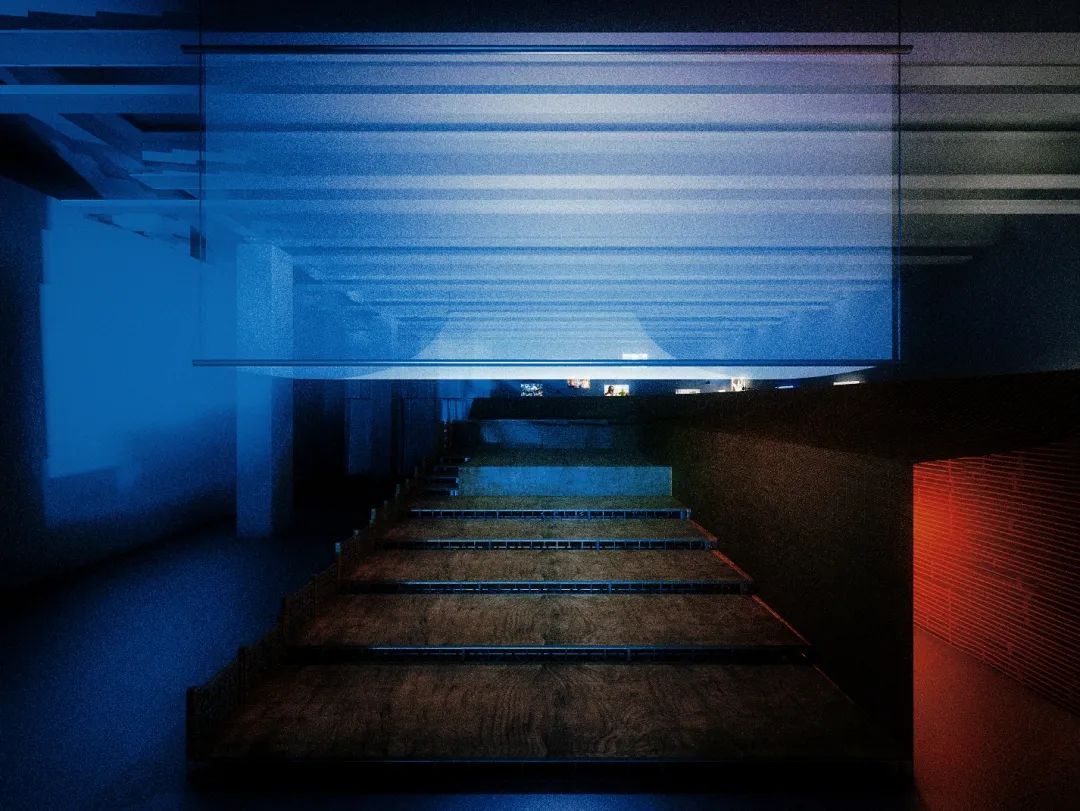
Martin Goya Business has used a playful register before to describe the condition of artists in Hangzhou, drawing a line between the city today and the Southern Song dynasty capital that once existed here in a kind of regional seclusion. Through that comparison, the collective suggested that artistic creation in Hangzhou still moves at a slow, free pace, held somewhat apart from political agendas. In 2018, shortly after the collective's founding, Martin Goya Business built a group exhibition, "Post-Southern Song Dynasty," around exactly this idea. In "Noon, Wildness, Stream, Washe, Ruins, Theatre," the eight-hour live performance occupies a third of a full day. As daylight shifts from noon into night, the sound environment turns from calm to turbulent, and audiences use flashlights to search the "ruins" and cave-like spaces of a fictionalized Hangzhou for elusive, indescribable "things." For this project, the curatorial team prefers the term "strong creation" to "strong curation" — the aim isn't to summarize an existing phenomenon, but to create a new condition, shaped collectively by initiators, artists, audience, and everyone else swept into it.
Producer: Tiffany Liu
Editor: Tiffany Liu
Designer: Nina
Image: From Power Station of Art