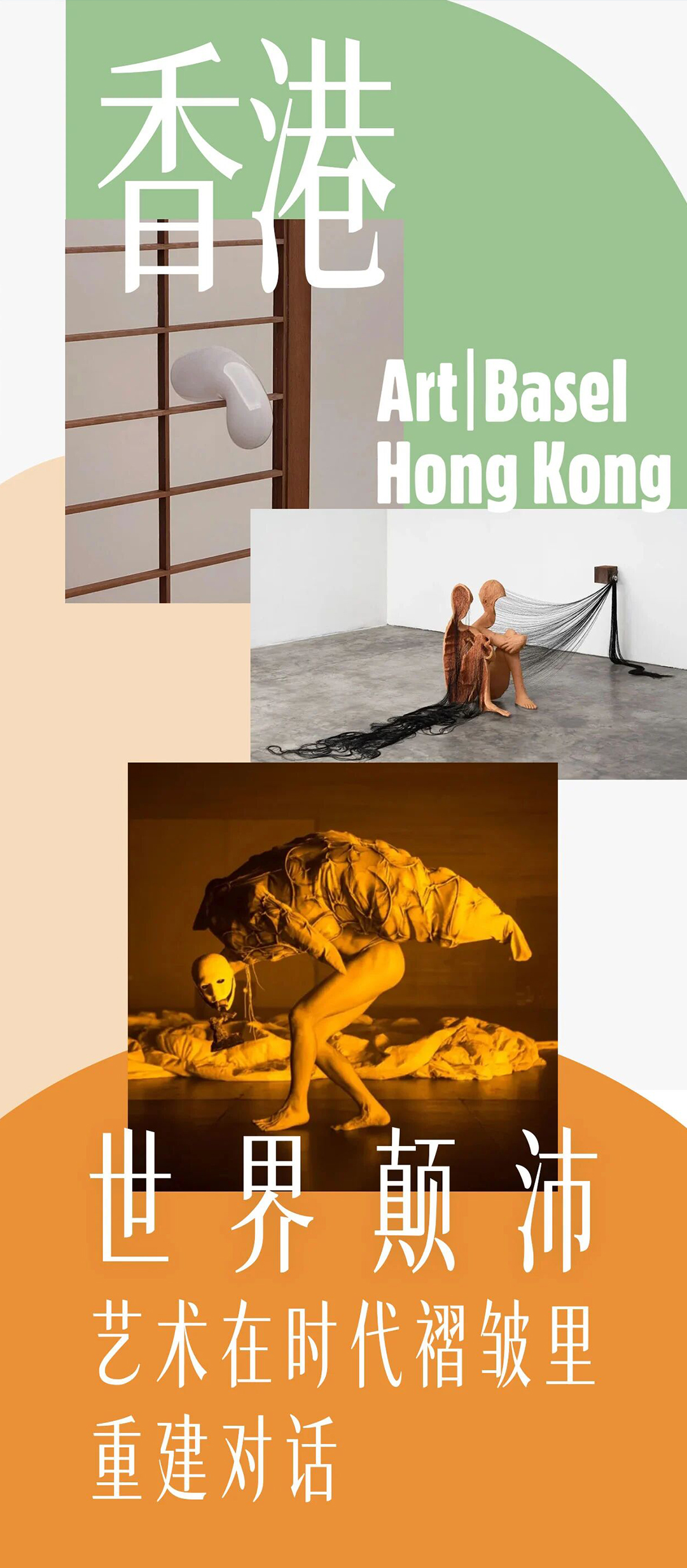
Spring returns once more to the southern seas. At this time of year, artists, curators, and gallerists—still emerging from the inertia of winter elsewhere—pack their bags in tacit unison, like migratory birds crossing the sky, landing on this complex island still widely regarded as the “heart of Asian art.”
Over the past week, we moved continuously through the dynamic landscape activated by Art Basel Hong Kong. From the grid-like booths of the Convention and Exhibition Centre to the extended social field across the island—and further into the cultural fabric of the Greater Bay Area—we followed the fair’s generative ecosystem while reflecting on a key question: amid geopolitical turbulence and shifting global narratives, how does art locate signals that connect to the future?
As one of Art Basel’s longest-standing hubs in Asia, the 2026 edition brings together 240 galleries from 41 countries and territories. Since 2023, the fair has rapidly recovered from pandemic-era disruptions: from 177 galleries in 2023 to a near one-third increase in 2024, stabilizing at around 240 in both 2025 and 2026. Notably, this year introduces the new “Echoes” sector, spotlighting under-recognized mid-career artists and mid-sized galleries, particularly from Asia.
1 / Migratory Gatherings: Assembling Market and Narrative Through Multiple Lenses
Each time I step into the Hong Kong Convention and Exhibition Centre—now home to Art Basel Hong Kong 2026—the briny breeze of Victoria Harbour mingles with the familiar scent inside the halls — a blend of paint, wood, and metal. This annual pilgrimage has, by now, become a years-long ritual, as automatic as a biological clock. And yet, amid the bustling, multilingual crowd, I can still sense something newly alive taking shape. As Art Basel's longest-established outpost in Asia, Art Basel Hong Kong remains the region's flagship fair. According to official figures, the 2026 edition brought together 240 galleries from 41 countries and territories. Viewed over a slightly longer timeframe, however, the fair's trajectory tells a broader story: since 2023, it has moved swiftly to overcome the disruptions to international travel and market confidence wrought by the pandemic.
The number of participating galleries rose from 177 in 2023 to 242 in 2024 — an increase of 65 galleries, or nearly one-third — effectively restoring the fair to its pre-pandemic scale. Participation then stabilized in 2025 and 2026 at around 240 galleries, with exhibitors representing 41 to 42 countries and territories each year. The 2026 edition also introduced Echoes, a new curated sector that turned the spotlight toward a segment of the market long overshadowed by blue-chip dominance: under-recognized mid-career artists and, in particular, mid-sized galleries from across Asia.
Since establishing itself in Hong Kong in 2013, Art Basel has remained both a barometer and pacemaker of the regional art ecosystem—simultaneously a “buoy in a sea of gold,” anchored by blue-chip galleries and high-value transactions.
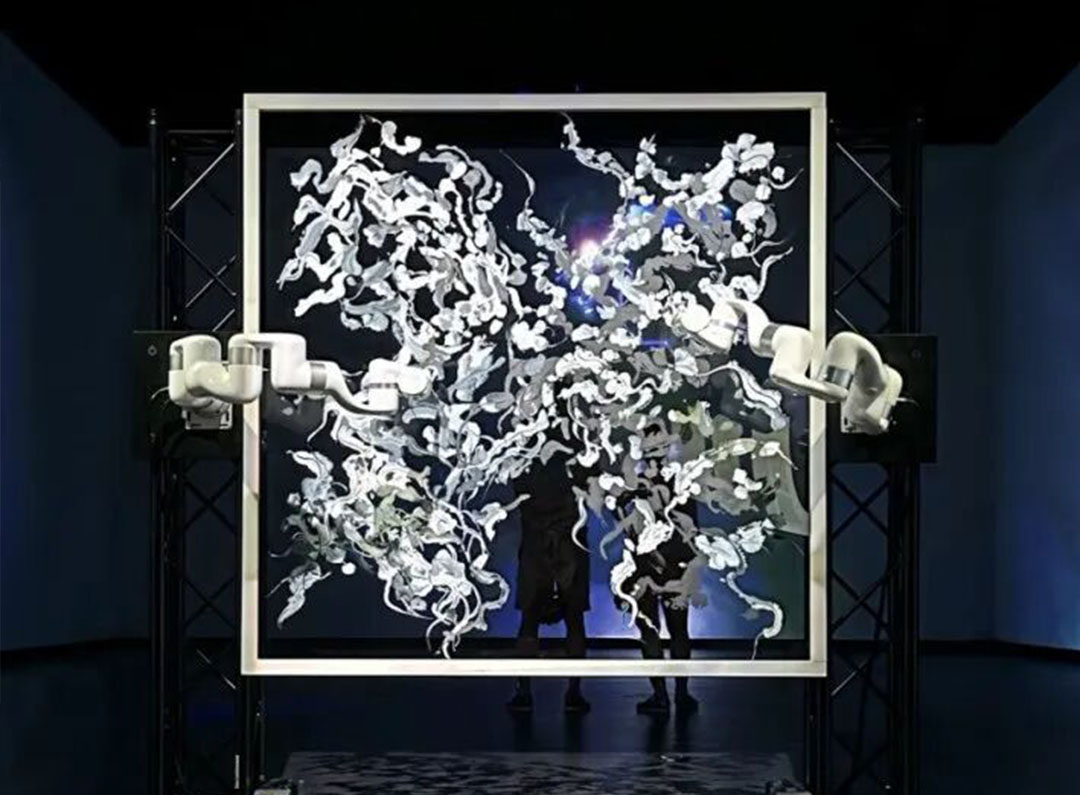
SPECTRAL – Oscillation 1, Munich, Sougwen Chung 2024,image courtesy of the artist and Fellowship x Artxcode
For now, let us draw back the curtain on the glamour and grand illusions and piece together the market's true contours from the many perspectives that shape its image and prevailing narratives.
Entering the main sector, galleries such as Gagosian, Hauser & Wirth, David Zwirner, and White Cube once again occupy central positions, reinforcing market stability. Hauser & Wirth, drawing on its formidable roster, secured major sales during VIP preview day, including Alexander Calder’s Horizontal, Pablo Picasso’s late-career four-panel painting (1965), and Louise Bourgeois’s sculpture “Couple”. The gallery also featured Chinese artist Qiu Xiaofei, whose “Dream Garden” paintings merge childhood memory with historical ruin. Meanwhile, Korean artist Lee Bul’s installation “Untitled” (“Infinity” Wall)—currently on view at M+—continues to articulate a distinctly Asian narrative framed within a Western discursive lineage.
Across the central aisle, David Zwirner deployed a similar strategy, weaving together artists across generations and geographies in a bid to edge closer to the summit of this fiercely contested marketplace. Long regarded as one of the world's foremost galleries for blue-chip art, the gallery featured major works by Marlene Dumas, Luc Tuymans, Yoshitomo Nara, and the Chinese painter Liu Ye, reaffirming its command of the global canon of contemporary painting. Pace Gallery, meanwhile, pursued a comparable balance. It anchored its presentation with Amedeo Modigliani's century-old masterpiece “Jeune femme brune” (Young Brunette), a historical touchstone that firmly established the booth's blue-chip credentials. At the same time, it signaled its continued commitment to Asia through Anicka Yi's new painting “0þR†KLñ†0W£” (2026), rendered in ultraviolet-cured ink across an acrylic topological structure, while recent works by Zhang Xiaogang, Mao Yan, and Wang Guangle traced key currents within contemporary Chinese art. This tripartite structure — canonical masterpieces, cutting-edge voices, and locally resonant practices — allowed the gallery to deliver the steady commercial performance expected of a blue-chip powerhouse.
Elsewhere on the fair floor, two works drew crowds and circulated widely across media, institutions, and audiences alike: the giant black sphere — Ryan Gander's conceptual installation “Can You Be Lonely and Happy”, brought by Tokyo's Taro Nasu gallery — and, just across the aisle, a cluster of translucent green speech-bubble balloons suspended mid-air by French artist Philippe Parreno, presented by Pilar Corrias. Of course, one could say at this point that capital has grown ever more conservative, consolidating itself ever more tightly around the industry's top players — a dynamic that inevitably makes the rich richer and the poor poorer.
In the Insights and Discoveries sectors, galleries from Ho Chi Minh City to Kyoto, Taipei to Montreal, drew on material experimentation, narrative, and historical consciousness to sketch a decentralized map of contemporary art across the second and third floors. Equally noteworthy was the strong showing of Chinese galleries — and the commercial momentum many of them generated — signaling how local artistic forces are staking an ever more assertive claim to discursive authority on an international stage such as Art Basel. Together with this year's newly introduced Echoes sector and the constellation of Encounters projects dispersed throughout the fair, these presentations offered an alternative way of seeing. Like stars scattered across the exhibition, they illuminated works that have yet to be fully absorbed — or fully priced — by the market, revealing creative practices that pulse with the urgencies of the present. Even the fleeting competition for visitors' attention became a sharp point of entry for revisiting overlooked histories of Asian modernism, drawing long-obscured narratives back into view.
From Ho Chi Minh City, Vin Gallery employed a restrained installation and deft lighting to present Japanese sculptor Ako Goto's ceramic skeletal forms. Their shadows, cast onto pristine white walls, unfolded like an uncanny shadow-puppet theatre, lending the fragile ceramic medium an almost spectral presence suspended somewhere between sculpture and performance.
From New York's Tribeca district, Sapar Contemporary introduced the work of Kazakh artist Aya Shalkar, whose methodology of "future archaeology" brings together performance, photography, and sculpture to reimagine the lost remains of nomadic civilizations. Rather than reconstructing history, Shalkar speculates on its possible afterlives, dissolving the boundaries between memory, fiction, and material evidence. For me, however, one of the most narratively compelling presentations in the Discoveries sector was PTT Space's solo project “Kindom”, by Atayal artist Ciwas Tahos. Rooted in the Atayal legend of Temahahoi,a secluded community of women said to inhabit Taiwan's deep mountain forests, the project led the artist and curator into the island's mountain ranges in search of these layered histories. The two-channel film “Perhaps, She Comes From/To__Alang” (2020) traces the flight paths of native honeybees, while handmade ceramic wind instruments interlace Indigenous oral traditions with queer perspectives. The result is a quietly powerful meditation on landscape, ancestry, and belonging. Previously presented at major international exhibitions including the Sharjah Biennial, its arrival at Art Basel Hong Kong served as a compelling affirmation of artistic practices grounded in Asia's own geopolitical and cultural imaginaries.
SPURS Gallery's represented artist Zhang Peili had, in the month and week preceding Art Basel Hong Kong, already staged his latest commissioned video work and a solo exhibition in the south — first at Tai Kwun, then at the Sea World Culture and Arts Center in Shenzhen. At the fair itself, however, the gallery placed its wager on a different project: the solo presentation "On My Mother's Lap" by Iranian-American artist Roksana Pirouzmand, which, in ways, echoed the gallery's recent exhibition in Beijing.
Pirouzmand's practice is grounded in her own history of migration: at the age of twenty-one, she moved to the United States through the HIAS refugee program, and her work has since revolved around memory, exile, and ancestral narrative. "On My Mother's Lap" continues her sustained inquiry into the body, family, and diasporic identity, taking form as an installation and mixed-media project that turns the "mother's lap" into a metaphorical space — at once a site of bloodline connection and a reconstruction after generational rupture.
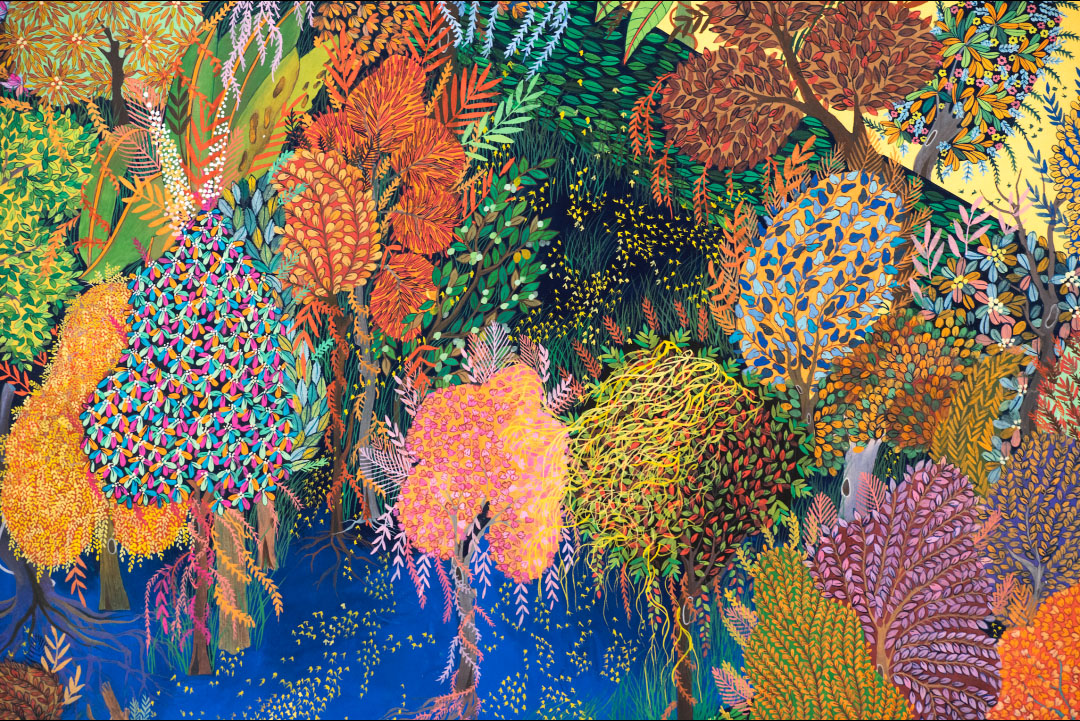
Walking with Light (detail), Wardha Shabbir, 2024, watercolor on acid-free paper; image courtesy of the artist and Sabrina Amrani Gallery
Capsule Shanghai and Klemm's joined forces in the Echoes sector to present a cross-regional exhibition featuring mid-career artists including Chen Litong and Yan Xinyue. Though formally distinct, their practices shared a remarkable technical assurance and an evident resistance to the pressures of market appeasement — what remained, instead, was a sustained commitment to personal expression and a thoughtful engagement with the conditions of the present. Across the fair, the familiar dynamic of Art Basel Hong Kong held: the interweaving of international and local perspectives, the productive friction between canonical works and experimental practices. From museum-grade masterpieces commanding seven-figure prices to emerging artists testing new visual languages;
From blue-chip galleries to independent spaces; from established masters to mid-career and younger generations — the fair offered a compelling cross-section of the contemporary global art ecosystem. Yet this year's newly introduced initiatives, with their heightened attention to Asia's art market and cultural ecology, pointed beyond the present moment, furnishing the fair with fresh coordinates — and renewed momentum — for the narratives still unfolding.
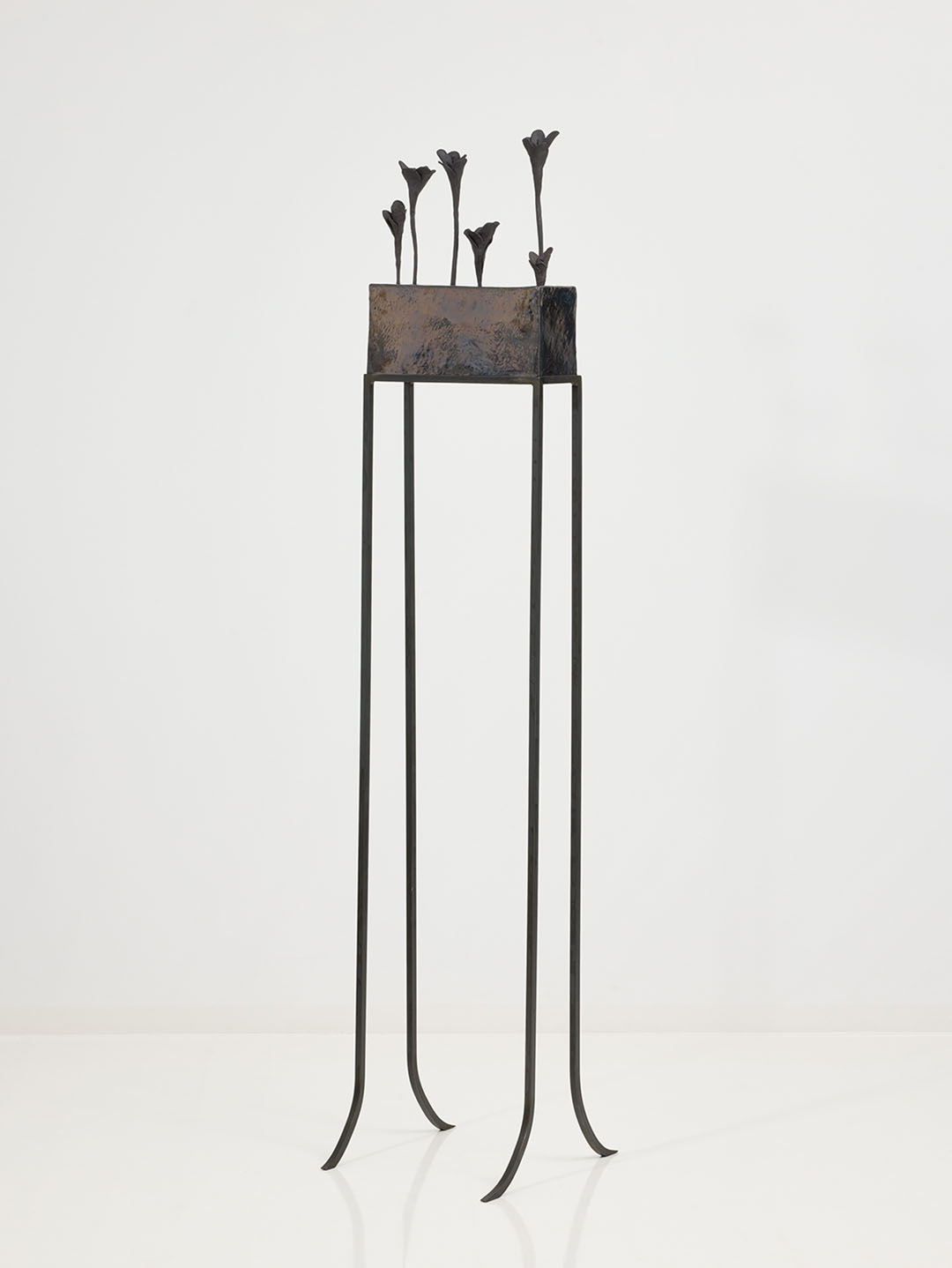
Borella, Elizabeth Jaeger, 2024, ceramic and blackened steel, 167.6 × 34.3 × 40.6 cm; courtesy of Capsule Shanghai.
2 / Mythic Terrains: Institutional Directions and Shifting Leadership
By the time one ascends to the second floor, the exhibition's interrogation of "concealment" suddenly turns inward — from an outer world pieced together out of historical fragments, to a metaphorical exploration of individual circumstance and contemporary identity.
As dusk settled over the city, the migratory flock dispersed from the Bauhinia Pier, drifting into parties in Central, banquets in Causeway Bay, and gatherings across the Southside. Buoyed by the festive, all-consuming atmosphere that Art Basel Hong Kong unfailingly conjures each year, a relentless succession of receptions, dinners, and late-night events carried wave after wave of friends from across the art world through Hong Kong Island. Alongside auctions, collector dinners, and industry salons, one observes a notable shift: collectors are no longer chasing speculative highs but making more measured, informed decisions.
In Central — this perennially bustling, expensive living room — the district's art-market ecosystem has been evolving rapidly in recent years, from the English-style Pedder Building, which developed almost in tandem with Art Basel's arrival in Hong Kong, to H Queen's, the purpose-built art tower offering the same floor heights but far more convenient exhibition renovations. Beyond the frequent turnover of gallery "tenants," this churn has also swept up the once red-hot Supper Club and now, its successor, Pavilions. All of this reveals a distinctly "Hong Kong" trait: even outside the fairs themselves, competition never sleeps in this city when it comes to business.
At the same time, Art Basel's gravitational pull has reinforced the institutional fabric on both sides of Victoria Harbour. Museums and non-profit spaces such as M+, Tai Kwun, CHAT (Centre for Heritage, Arts and Textile), and Para Site not only serve as key pillars of Hong Kong's — and, by extension, the Greater Bay Area's — artistic landscape but also extend participation in the city's art week well beyond the fair's opening hours. Together, they function as the ecosystem's most effective off-site "cooling chambers": spaces where the frenetic pace of the market gives way to slower forms of engagement, helping regulate the cultural temperature of the wider system and sustain its long-term health. It is precisely this balanced ecology — one in which commercial momentum is continually moderated by strong institutional infrastructure — that remains a scarce and largely unrealised asset across much of Asia.
During Art Basel Hong Kong, M+ foregrounded two newly commissioned works. Pakistani American artist Shahzia Sikander's monumental hand-drawn animation Territorial Drift (2026) unfolded in a continuous loop across the museum's LED façade, drawing on the visual language of Persian and South Asian miniature painting to trace a century of entanglements between empire and maritime power. Meanwhile, Tai Kwun extended artistic engagement beyond the white cube and into the public realm. On Friday evening, its annual Artists' Night, themed “Embodied Knowledge”, brought together a diverse program of live performance: Sydney-based artist Justin Talplacido Shoulder presented the solo work “Carrion” ; Korean interdisciplinary artist Geumhyung Jeong invited audiences into the participatory performance “Fire Drill Scenario” and the Tibetan Plateau post-rock band Tiansheng made its Hong Kong debut “The Sensation Quintet”. Elsewhere, the exhibition Remain in Touch: Global Supply at JC Contemporary extended its opening hours into the evening, while Filipino American sound artist Lydo transformed one of Tai Kwun's former air-raid shelters into an introspective chamber of listening with the site-specific installation “Nervous System”.
CHAT extended its presence well beyond its Tsuen Wan home during Art Basel Hong Kong. In addition to presenting the exhibition “Lining Revealed” ahead of the fair, the institution devoted its booth at the fair to early paintings by Hong Kong artist Chan Wai Lap. Elsewhere, his newly commissioned immersive installation Mimimomo Pool (2026), presented in the UBS Art Studio, took the form of a large circular swimming pool devoid of water, lined instead with blue, violet, and silver ceramic tiles. Borrowing its title from the Cantonese onomatopoeic slang "磨磨蹭蹭” (mi mi mo mo) — a playful expression for dawdling or lingering — the work invited fairgoers to slow their pace, suspending the relentless rhythm of the fair in favor of a quietly ritualistic encounter that momentarily shed the habits of everyday life.
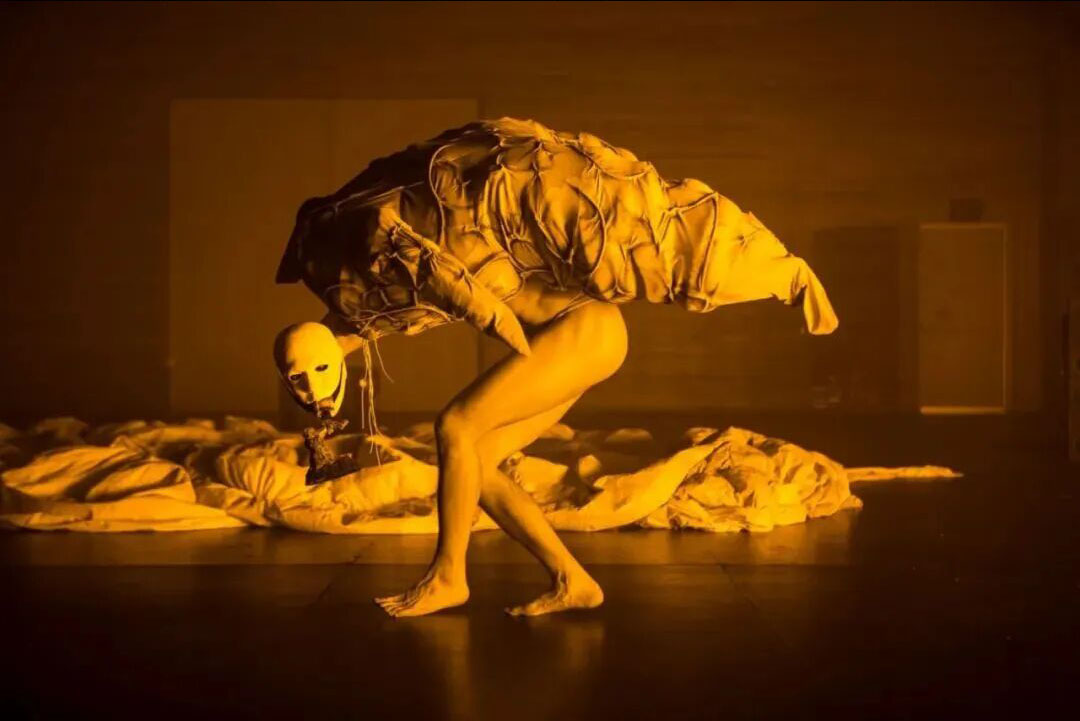
Carrion,Justin Talplacido Shoulder image source,Photo:Alex Davies
This year also marks the thirtieth anniversary of Para Site, Hong Kong's pioneering independent non-profit art institution. Under the year-long celebratory program “Para Site: 30 Years”, the institution inaugurated its first anniversary exhibition, “Site-seeing”, on 14 March. Bringing together nine artistic practices — including Tolia Astakhishvili, Zhang Yiman, Kung Ka-wei, Ko Sin Tung, Nawin Nuthong, Anna Sew Hoy, Wang Bo and Pan Lü, Zheng Tianyi, and Zhong Diming — the exhibition employed installation, moving image, and sculpture to reflect on the shifting relationship between urban space and collective memory in the contemporary city.
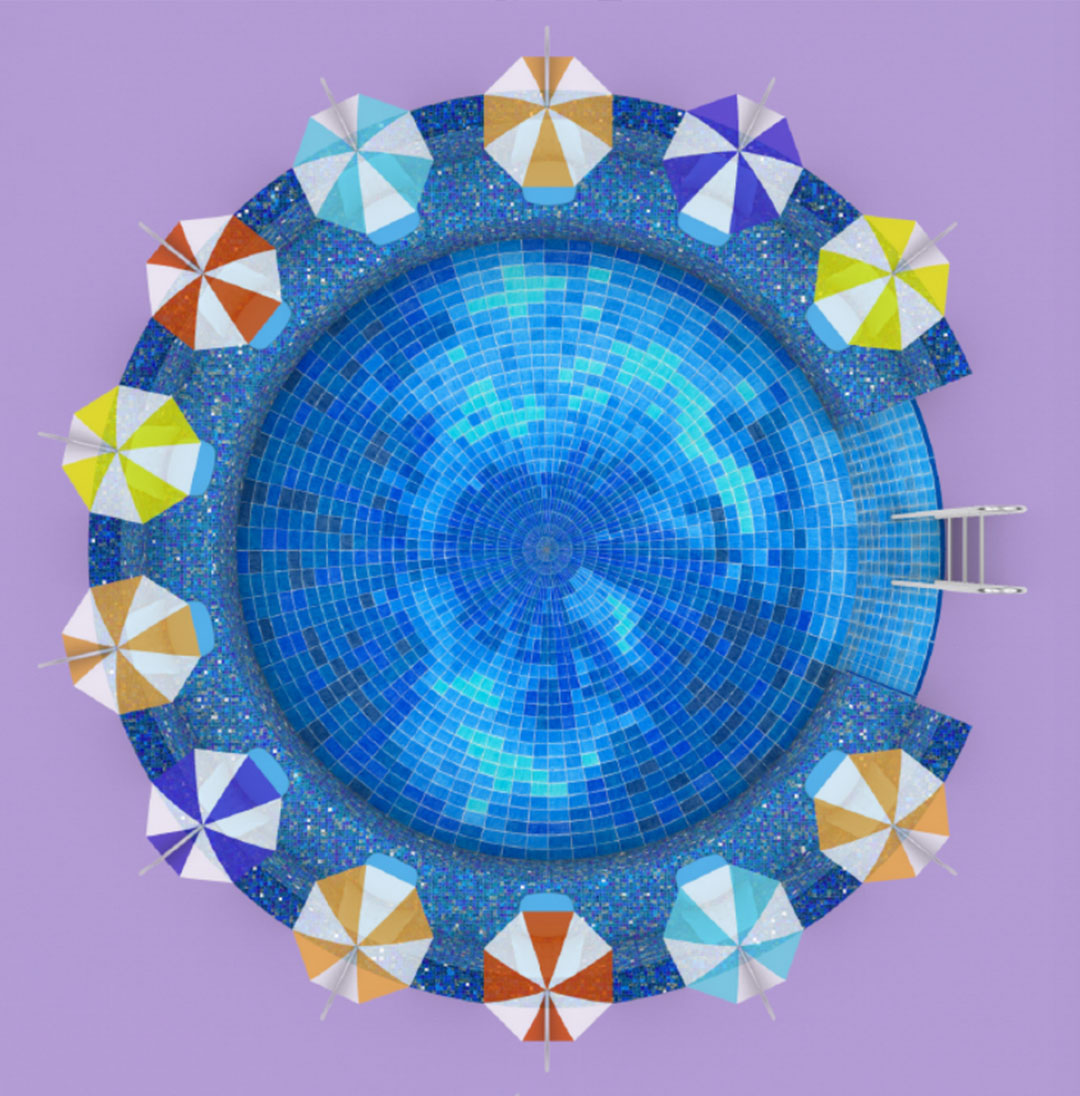
Mimimomo Pool,Chan Wai Lap 2026,glass mosaic tiles, ready-made objects,1000 × 6000 cm, image source | artist and Gallery Exit
What emerges, then, is a picture of Hong Kong's local institutions absorbing the fair's radiant spillover while, at the same time, carefully staking out their own discursive territories — the academic remaining academic, the communal remaining communal, each holding its avant-garde edge even as it gestures back toward the archive. In recent months, the Greater Bay Area's art ecology has likewise seen a wave of personnel changes, an old order giving way to a new one. Now that every institution has found its "role" within Basel's spotlight, the question remains: has the region's southern art ecosystem truly grown more dynamic and plural — or has it simply settled into a clearer, more orderly arrangement, each part keeping politely to its own lane?
3 / Intermission: Allowing Time for Getting Lost, Encounter, and Return
In an era marked by geopolitical tension and global fragmentation, the continued presence of Art Basel Hong Kong testifies to the resilience of art. It has built a platform for exchange — one that transcends geopolitical conflict, using art as a connective thread across the world, and standing as a vital anchor for global culture in uncertain times. It reminds us that even as circumstances grow complicated, art retains its resilience to connect, carrying the warmth of culture across divides.
Looking ahead, the question remains: what kind of art ecosystem should Hong Kong—and the Greater Bay Area—construct? Across mainland China, from Beijing’s 798 to Shanghai’s West Bund and Shenzhen’s Houhai district, development has often followed similar models. Hong Kong offers a different proposition: beyond infrastructure and scale, a true art city must cultivate space—for perspectives, emotions, and values—to allow what lies hidden in the folds of time to grow organically. Only then can we begin to speak of what comes next for the so-called "local art ecosystem." Making art was never meant to be a matter of excessive noise or anxiety. To stay alert, to keep questioning, to remain present, to remain open to the unknown — this, in the end, is how one finds one's own bearings in turbulent times.
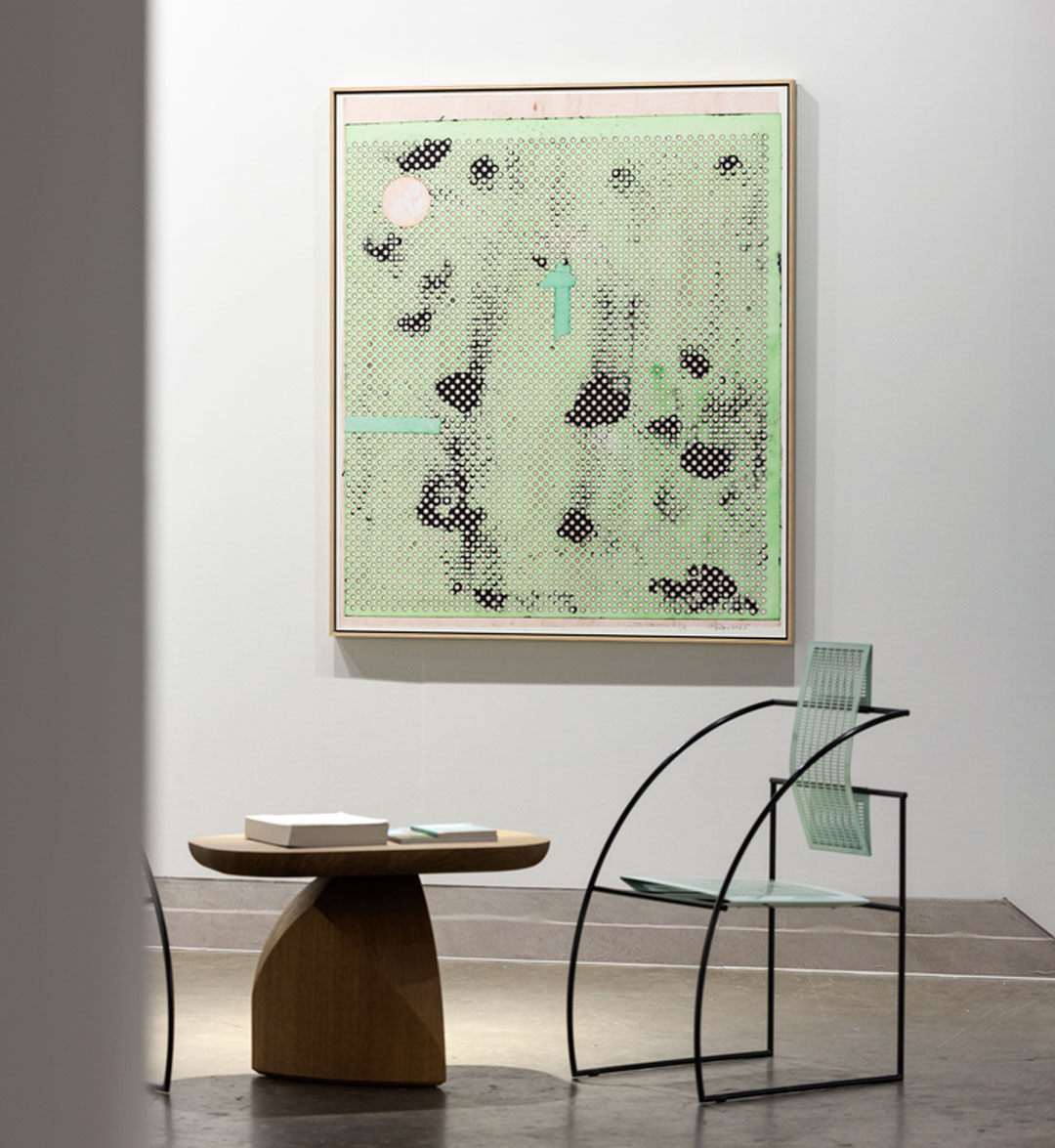
Liang Quan, Rain at Dusk, Archival UV print on aluminum pane, 140×120cm, 2025 © MANGROVEGALLERY
Producer: Tiffany Liu
Editor: Tiffany Liu
Designer: Nina
Image: From Art Basel Hong Kong, various galleries mentioned in the article, and on-site by Oui Art



