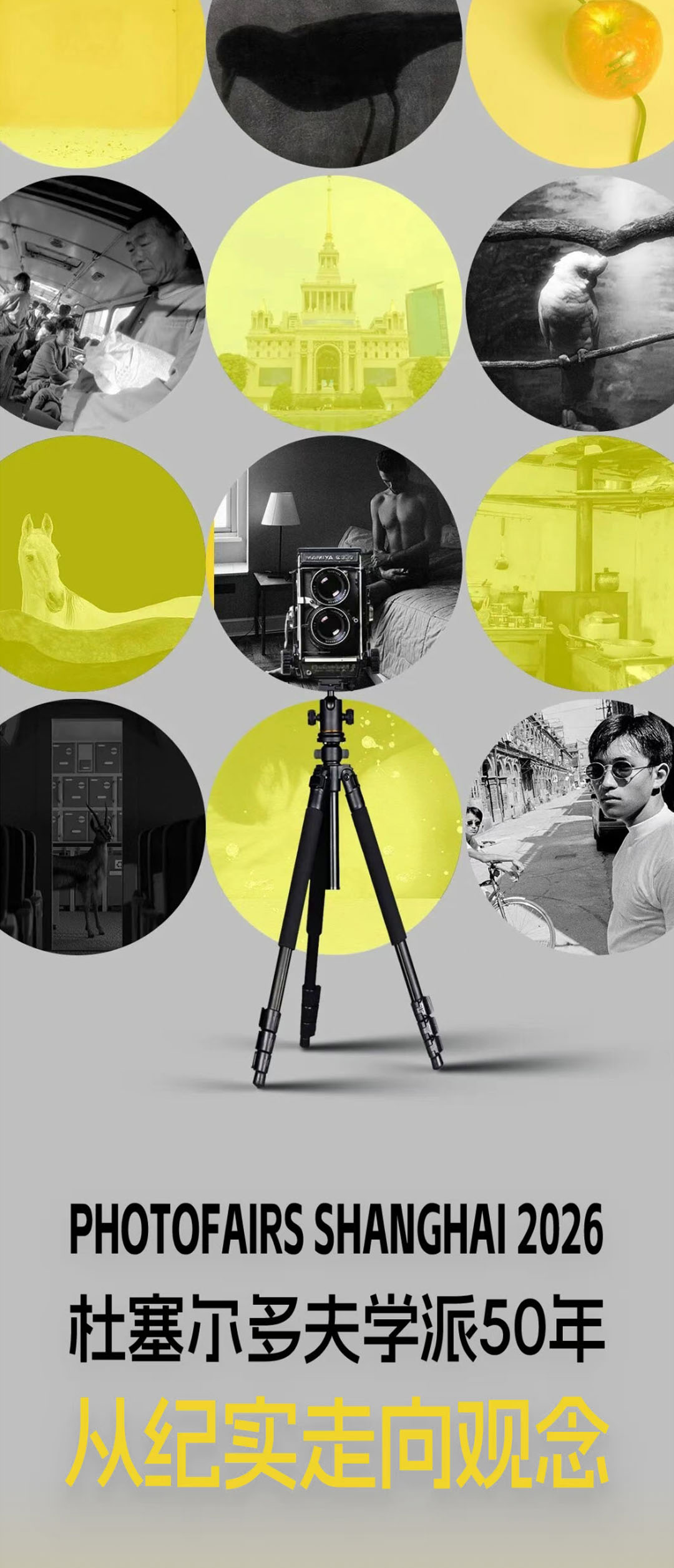
Photography has never been merely the act of pressing a shutter. It is a medium through which artists project systems of seeing, memory, and perception. Returning to the Shanghai Exhibition Centre this May, the 11th edition of "PHOTOFAIRS Shanghai" brought together more than fifty galleries and institutions from China and abroad, presenting image-based practices that move fluidly between photography, installation, digital media, and conceptual art.
Across photography's two-hundred-year history, each technological shift has transformed not only how images are produced, but how reality itself is constructed. From film to digital imaging, from the "decisive moment" to staged tableaux, from documentary photography to AI-generated imagery, photography has long exceeded its original documentary function. It has become a philosophical and aesthetic language through which artists negotiate truth, fiction, memory, and mediation.
One of the most influential movements in this transformation was the Düsseldorf School. The fair's central exhibition, "Art ⇔ Photography," traces fifty years of the school's evolution, opening with monumental, large-format works before expanding into the media experiments of younger generations. Together, these works reveal how the Düsseldorf School continues to shape contemporary image culture while constantly revising its own visual grammar.
The Düsseldorf School at PHOTOFAIRS Shanghai
The Düsseldorf School, long associated with the legacy of German "New Objectivity," emerged in the 1970s around the influential duo Bernd Becher and Hilla Becher. Through their systematic documentation of industrial architecture—water towers, blast furnaces, cooling towers, and factories—the Bechers created a typological archive of disappearing industrial civilization. Among their most renowned students were Andreas Gursky, Candida Höfer, and Thomas Struth. Though all inherited the Bechers' typological discipline, each developed a radically distinct visual language.
Andreas Gursky, the artist behind “Rhein II”, the single photograph that set a record-breaking auction price, is known for shooting on large-format view cameras and then digitally recombining the resulting images. His monumental, artificial landscapes read as though viewed from some godlike vantage point, where individuals dissolve into mere specks of dust within the vast machinery of modern society. Candida Höfer works in a different register entirely. She turns her camera on architectural spaces that stand as symbols of human civilization, while stripping away every trace of human presence within them. Working with long exposures, natural light alone, and no post-processing, her method reads almost like an exchange—time given over in return for a tender, contemplative gaze at architectural detail. In Höfer's photographs, museums hold an eternally solemn and silent expression, and the documentary function of photography approaches something close to perfection.
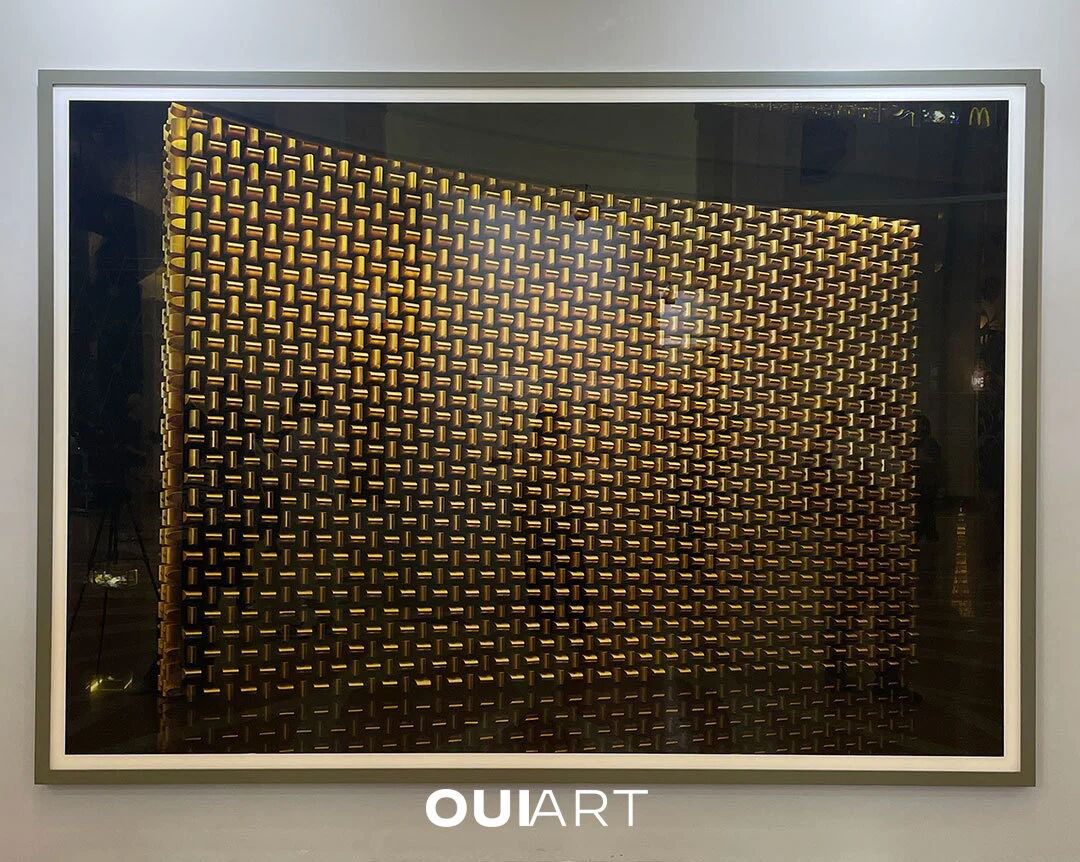
Las Vegas, Andreas Gursky, 2022, Sprüth Magers, exhibition view, photo: Tiffany Liu
Thomas Ruff, by contrast, treats even documentary reality as something staged in advance. He describes his own work as an investigation into "the grammar of photography," ranging across portraiture, architecture, astronomy, technology, news imagery, and art. "I believed that photography captures reality, or can capture reality," he has said. "But then, when I began working on the portraits, I stopped believing it. Of course, the camera records what's in front of it, but that reality can be pre-arranged." Beginning with this skepticism toward photography's claim to truth, he turned instead to studying how photography works—its mechanisms and technical processes. Ruff wryly refers to his own practice as "researching the grammar of photography."
A New Generation of the Düsseldorf School
Over the past five decades, the Düsseldorf School has evolved from documentary observation into conceptual inquiry; from meticulously crafted large-format prints into digitally mediated image systems; from photographing reality into appropriating, dismantling, and questioning the image itself. Yet its influence on contemporary photography remains remarkably persistent.
At the entrance of the exhibition stands one of the Bechers' iconic water tower photographs. Arranged around it in an arc are works by younger artists including Sebastian Riemer, Jürgen Staack, the artist duo Hedda Schattanik and Roman Szczesny, and Alex Grein. While inheriting the typological logic of earlier generations, these artists shift their attention toward instability, fragmentation, material decay, and the uncertain status of images themselves.
Alex Grein, for instance, explores how digital images might recover a sense of material presence within an increasingly immaterial visual culture. In one three-channel video installation, butterflies rest atop iPad screens displaying Google Earth. By digitally navigating toward the insects' original habitats, the work imagines a poetic gesture of "bringing endangered butterflies home."
The Düsseldorf School today no longer clings to traditional representation. Digital technologies—and increasingly artificial intelligence—have become both medium and subject. Rather than celebrating technological fluency, however, many younger artists use AI critically, exposing the instability of image production itself. In his V1S10N series, Jürgen Staack references the resurgence of Romantic landscape painting prompted by the 250th anniversary of Caspar David Friedrich. Friedrich's iconic motifs—mountains, barren trees, ruined churches—are grotesquely distorted into uncanny digital landscapes, satirizing the frictionless perfection of AI-generated scenery.
At the opening forum, an anxious audience member asked Valeria Liebermann, curator of "Art ⇔ Photography," a pointed question: with the rapid iteration of big data, would photographers eventually be reduced to mere image-generation tools sitting in front of a computer? She paused to think, then replied: "Photography's history spans only two hundred years so far. There was once a time when people declared painting would die, since photography was a better brush for capturing nature. Looking back now, photography didn't destroy painting at all—instead, it pushed painters to rethink their own fundamental questions. Photography, too, will keep iterating on itself, because AI can look and copy, but an artist, in the act of looking, also learns."
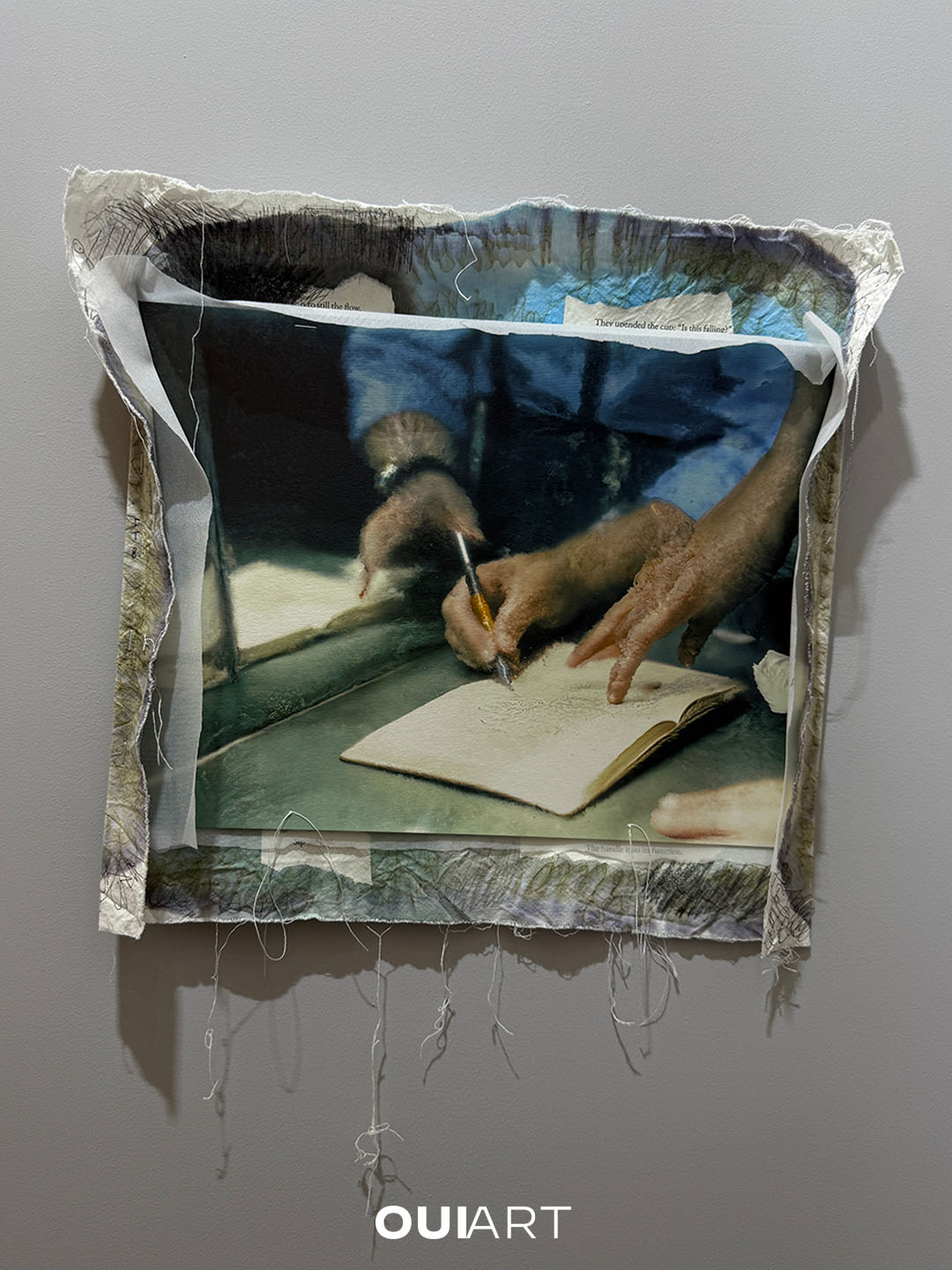
Test Time 19, Hedda Roman 2025, ThisThat Gallery, on-site photo: Tiffany Liu
Contemporary Chinese Artists Respond
The exhibition also positions four Chinese artists—Yang Di, Shi Yangkun, Gao Yutao, and Liu Shiyuan—in dialogue with the Düsseldorf School’s modes of seeing. Through photography, installation, and moving image, their works incorporate local experience while confronting broader questions surrounding memory, mediation, and visual perception.
Also drawing on Friedrich’s imagery, Yang Di—who graduated from the Kunstakademie Düsseldorf—offers a counterpoint to Staack’s AI-inflected landscapes in his work “Ideal Scene”. Based on a typological study of window structures from different architectural periods in Shanghai, Yang reconstructs fragments of urban windows while stacking white foam boards into iceberg-like formations. Referencing Friedrich’s “The Sea of Ice (Das Eismeer)”, the work reflects on failed utopian aspirations and the collapse of everyday “experience.”
Gao Yutao, likewise, trained in Düsseldorf, works across photography, installation, performance, and video. Speaking about the exhibition layout, he observed that “the water tower almost becomes a signal tower, with our works orbiting around it.” His “four seasons” series uses a flatbed scanner to image mineral specimens, shifting between microscopic and cosmic scales in a distinctly Eastern mode of perception reminiscent of the Buddhist concept of “Mount Sumeru contained within a mustard seed.” Even stray cat hair from the artist’s studio appears enlarged within the scans as an “automatic accident.”
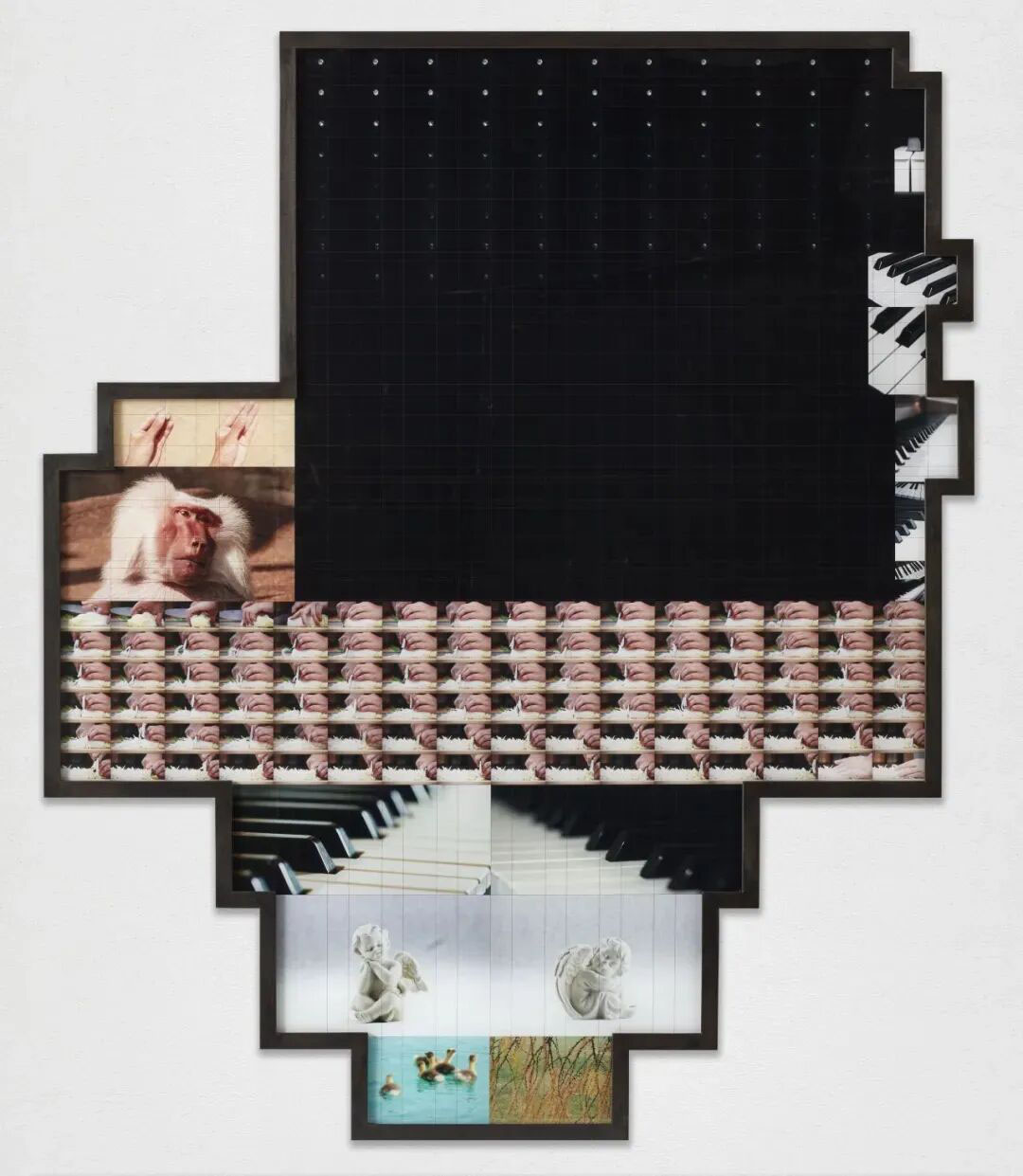
Almost Like Rebar , No.7 Liu Shiyuan, 2018 Image courtesy of the artist and WHITE SPACE
Both Liu Shiyuan and Shi Yangkun appropriate historical imagery to explore the visual construction of memory. Shi, who previously worked as a photojournalist, reactivates archival materials within contemporary contexts. Liu’s collage-photography work “Almost Like Rebar” assembles mold stains, textile patterns, and blurred portraits into fragmented compositions framed by irregular cuts and visual disjunctions. Sourced from failed commercial photography websites, these images probe the instability of perception and the shifting mechanisms through which visual meaning is produced.
Romantic Realism and the Persistence of Beauty
Moving through the fair, one realization becomes unavoidable: romantic realism in photography has never truly disappeared.
The camera is not a neutral recording device; what it captures within the frame is always determined by whoever stands behind the lens. Whether in the age of film or today, there have always been artists faithful to the sensibility that realism brings — beyond the "expressionless" strain of conceptual photography, there exists a wealth of human expression, a precise command of light and shadow, and an endless devotion to depicting nature, all rendered through a visual language of narrative that gives form to humanity's eternal proposition: the flow of emotion and the experience of beauty.
Michel Sima (1912–1987), originally trained as a sculptor, began photographing portraits of Picasso in 1946. A witness to the flourishing of postwar art, Sima was closely tied to the artists of the École de Paris, and brought a sculptor's sensitivity to light and shadow to his portraits of his contemporaries — revealing these masters in unguarded, little-seen moments of relaxation and creative process, set within spaces they knew intimately.
Three Shadows Photography Art Centre is spotlighting Wang Wusheng's black-and-white photographs of Huangshan, rendered in the spirit of splashed-ink landscape painting. Also taking the mountain as its subject, Maison Européenne de la Photographie brings a volcano project by artist Ilanit Illouz, paying tribute to the earth's landscapes — photographing Italy's still-erupting Mount Etna, she captures the surging vitality at the rock's edge along with the flow of the lava that once shaped it, while also revealing the singular character of this land. In making these photographs, the artist embeds grains of salt into the surface of the work, rendering a crystalline, mineral-like texture.
Robert Mapplethorpe's classical black-and-white photography was, in its time, deeply subversive. Gladstone Gallery presents a landmark solo project of his, including the calla lilies he became enamored with photographing beginning in the 1970s, alongside rarely seen images of ocean waves and horses — the sculptural quality of flowers set against the lines of the human body, distilled down to their essence, revealing an intrinsic, unified sense of sculptural form within the object itself.
Interestingly, at the neighboring An Space, new media artist Ivona Tau presents her own "Calla Lily" — inviting direct comparison with Mapplethorpe's aesthetic paradigm, a re-measurement of the curve, classical versus algorithmic. The artist built her own proprietary AI system specifically to resist the mimicry of big data, redefining questions of copyright ethics and bodily boundaries in the digital age — artificial intelligence set against the classicism of the silver-gelatin era. This once again underscores that an artist's use of artificial intelligence in creation is not synonymous with laziness or cheap shortcuts; the artist remains sensitive to this very tension, turning the algorithm back against itself so that the resulting work becomes something irreducibly singular.
This year's photography fair opens with an exhibition marking fifty years of the Düsseldorf School, revealing photography's crucial pivot from "nature's brush" toward conceptual art. Gombrich's famous dictum — "There really is no such thing as Art. There are only artists" — holds equally true in the field of photography. Even as artists adapt to the times, they are rethinking what images mean, systematically dismantling the grammar of photography, and attempting to answer how the image might endure in the digital age. Photography, as a medium in which heart and hand become one, makes reflecting on the value of looking especially precious in an age of algorithms: beginning in sight, passing through emotion, and existing, ultimately, for the sake of thought.
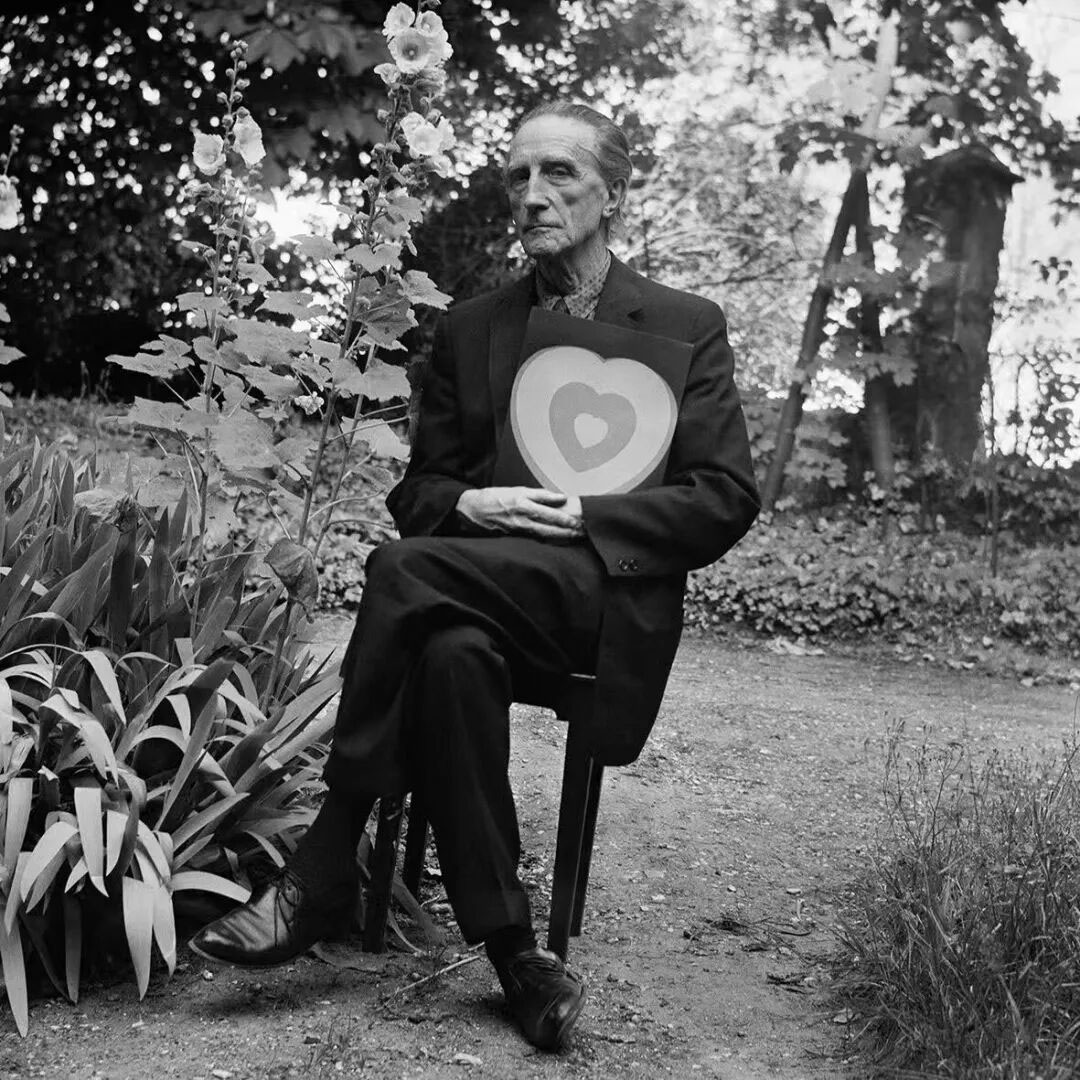
©Michel SIMA, Marcel DUCHAMP, 1955, courtesy of Boogie Woogie Photography & The Sima Estate
Producer:Tiffany Liu
Editor:Tiffany Liu
Designer:Nina
Image: Taken from the PHOTOFAIRS Shanghai and Oui Art on-site



