
The 61st Venice Biennale, held in 2026 under the title In Minor Keys, was conceived by the late curator Koyo Kouoh as an invitation to return to the deep entanglements between art and social ecologies—to emotion, perception, subjectivity, and the subtle registers of human experience.
Yet In Minor Keys also serves as an unexpectedly sharp diagnosis for another architecture entirely, one that rarely finds its name on gallery labels: the queues, the waterways, the shifting shadows, the air, the distance, the seating, the humidity, and the sound. To live through an exhibition is to endure these conditions. They form its true, anonymous infrastructure—a lattice of invisible systems that quietly dictate how art is met. They are not artworks, yet they fundamentally rewrite what an artwork becomes.
In Venice, encountering art requires a minor migration. Waiting for a vaporetto. Boarding. Disembarking. Walking. Queuing. Finding an entrance. Navigating a sea of shoulders. Rechecking maps under the heavy, humid heat. By the time a body finally stands before an artwork, the first encounter has already passed. The work has been pre-authored by the lagoon, the waiting lines, the sweat, the shade, and the exhaustion. We imagine ourselves looking at the object. What the object sees, however, is a body already heavily revised by its environment.
The Exhibition Does Not Begin at the Entrance
The Venice Biennale stretches across the Giardini, the Arsenale, dozens of collateral exhibitions marooned throughout the city, and the distant mainland outpost of Forte Marghera. Simply unfolding the map is an exercise in structural triage: where to begin, what can still be rescued afterward, and what will inevitably be abandoned.
The Giardini and the Arsenale demand either a punishing march or a transfer by boat. National pavilions sequestered within Venetian palazzi require an active, almost forensic search—turning down blind alleys, arching over bridges, hunting for doorways that look like anything but entrances. Forte Marghera, meanwhile, remains a destination visited almost exclusively by those willing to make a deliberate, secular pilgrimage.
One particularly telling curatorial choice placed the works of Temitayo Ogunbiyi, Uriel Orlow, and Fabrice Aragno at Forte Marghera. The site was imagined as a landscape for wandering, play, interaction, and respite, where visitors might recline on the grass beside Ogunbiyi’s sculptures and let their minds drift. It represented perhaps the most tender translation of In Minor Keys, yet its very distance ensured it remained largely unvisited. The exhibition’s gentlest gestures were quietly filtered out by geography.
In most cities, exhibition routes are choreographed by curators. In Venice, they are drafted by water.
The real exhibition map is never the printed one. It is a shifting ledger composed of vaporetto timetables, walking distance, dock locations, transfer windows, and pure physical endurance. What we see—and what we are forced to skip—is determined to a staggering degree by the logistics of transit. Art here is quietly redistributed by the politics of access. The harder a work is to reach, the more exclusively it belongs to the most determined, or the most privileged, among us.
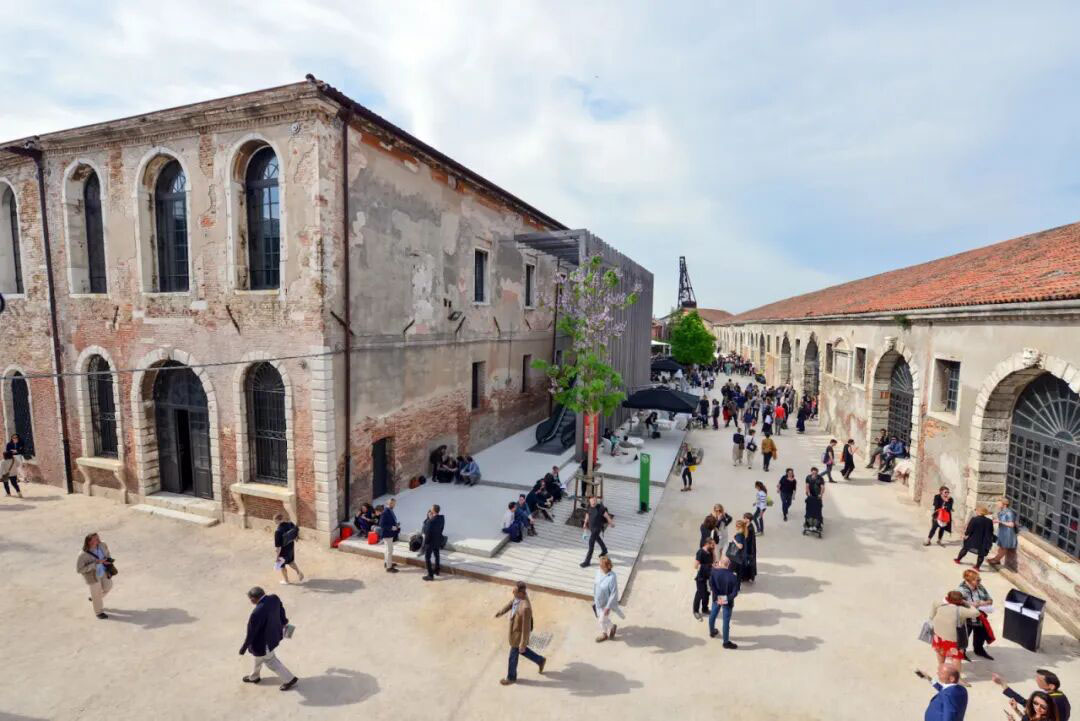
Venice Biennale on-site, 2026
Queues: The Artwork’s First Rewrite
In a queue, we slowly accumulate a collective desire, a manufactured sense of scarcity, and a silent, mutual agreement: this is worth waiting for. A pavilion breached after forty minutes of standing is fundamentally distinct from one entered on a whim. Even if the artworks inside are identical, the internal landscape is not. The body has already been warped and molded by anticipation, impatience, creeping exhaustion, and the petty, triumphant glow that rewards sheer endurance.
This year, the performance piece Seaworld Venice by Austrian Pavilion artist Florentina Holzinger galvanized the Biennale crowds. Deploying naked torsos, a swinging pendulum, and a circulating water tank filled with the audience’s own urine, the work epitomized an art inseparable from the live event. In this pressure cooker, the queue itself dissolved into the spectacle, becoming a part of the publicity machine.
On the second preview day, I joined the line for a deliberate three hours—partly driven by a journalistic curiosity to see how long the wait would become. Stranded outside the entrance, I watched the performance cycle three times, marking the passage of each hour by the rhythm of the stage. Holzinger used her own naked body as a human clapper, swinging to strike a massive bronze bell salvaged from the depths of the Venetian Lagoon.
Before I ever crossed the pavilion’s threshold, the work's heavy affective climate had already colonized the sidewalk outside. Meanwhile, at the nearby Japanese Pavilion in the Giardini, an entirely different sociology of the queue was playing out. Here, artist Ei Arakawa-Nash required every visitor to adopt a lifelike baby doll upon entering. Weighing roughly four kilograms—the heft of a four-month-old infant—the doll became each visitor’s shadow throughout the space. Some critics prematurely labeled the Japanese Pavilion one of the Giardini's few "quiet oases" (a claim that feels somewhat romanticized). The moment visitors received the baby after waiting in line, the exhibition immediately reconfigured the visitor's bodily relation to the space.: the audience became caregivers.
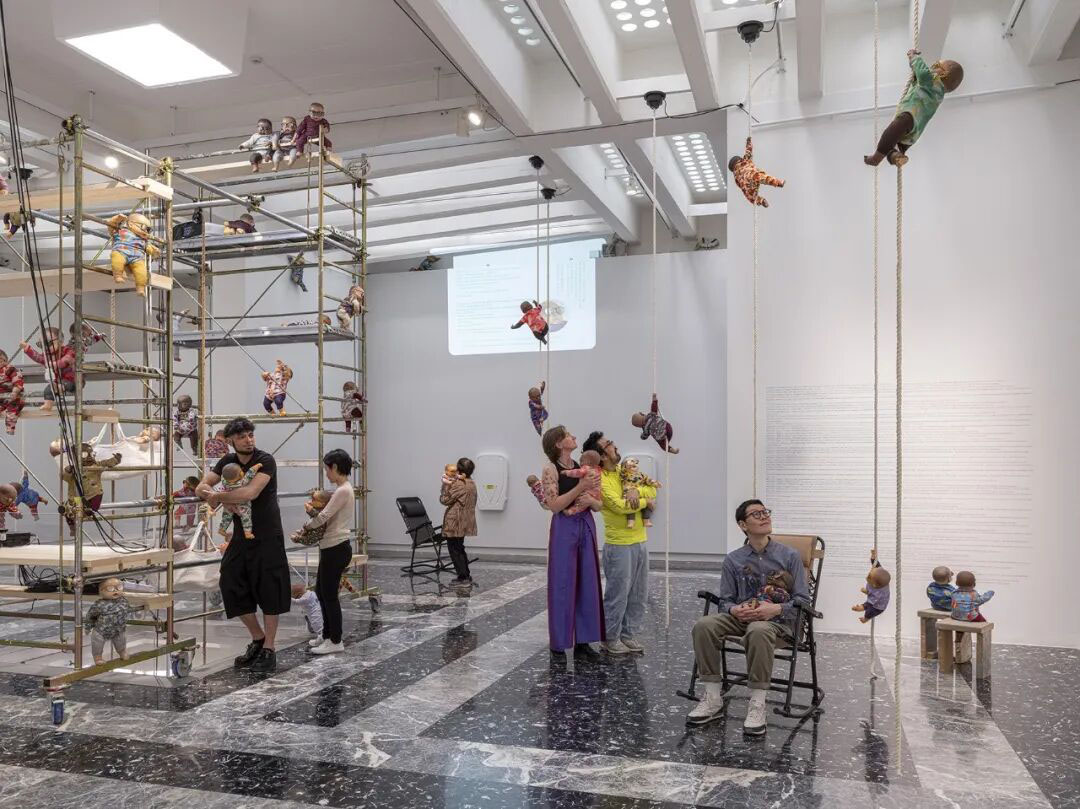
Ei Arakawa-Nash Installation, Venice Biennale on-site, 2026
Both instances converge on the same diagnosis: the queue is never an external chore. The queue is the exhibition's true antechamber. It is the crucible where the artwork's emotional frequency is first tuned, and where the text of the audience begins its subtle, involuntary rewrite.
Air: The Biennale’s Hidden Material
The Arsenale's Corderie—the grand spine of the Biennale’s central international exhibition—sprawls through a former rope factory stretching nearly three hundred meters. Its oppressive brick walls, low-slung timber beams, and thick, stagnant air have turned entry into a sensory rite of passage over the decades. Visitors are funneled through a dim, damp transitional chamber thick with the scent of weeping stone and centuries-old wood before spilling into the cavernous main hall. To walk this expanse is to move through an environment of distinct, suffocating gravity.
This atmospheric heaviness is a physical reality: it alters the rhythm of breath, drags at the heel, and slowly erodes emotional stamina. This iteration of the Biennale speaks urgently of the Global South, displacement, systemic trauma, spirituality, mourning, and radical tenderness. In a sanitized white-cube gallery, these risk remaining clean, academic concepts. Encased within the dense, humid climate of the Arsenale, they are forced back into the marrow of the body.
Indeed, one of the most pervasive, phantom strategies across this year’s Biennale is the excessive use of scent. Times and again I encountered standard museum labels bearing such warning: “This artwork contains natural fragrances and aromatic substances.” American artist Cauleen Smith’s video installation The Wanda Coleman Songbook arrives saturated with the specific, golden-hour atmosphere of public parks in Los Angeles. Elsewhere, Carsten Höller’s works are haunted by the intimate, domestic odors of his parents’ everyday belongings. In Manuel Mathieu’s video installation Pendulum, a cloud of patchouli and vetiver colonizes the air— the work is, too, paired with a companion scented candle, allowing visitors to purchase and pocket a literal "fragment" of olfactory memory to exhume at home. Meanwhile, Dan Lie’s installation strings together heavy, decomposing masses of fresh flowers with coarse sea rope, suspending them like modern vanitas paintings throughout the architecture. The India Pavilion, by contrast, manufactures a more ancestral terroir: a calculated blend of bamboo, damp clay, and rising dust, designed to evoke what its creators describe as “the familiar smell of someone’s home.”
These olfactory interventions comprise the most un-documentable dimension of the exhibition. They stubbornly defy photography and Instagram circulation, yet they lodge themselves deepest in the memory. Scent bypasses intellectual defense and strikes directly at the nervous system. In a Biennale deeply preoccupied with grief, convalescence, trauma, and the labor of remembering, scent reveals itself as perhaps the exhibition's most urgent, and devastating, medium.
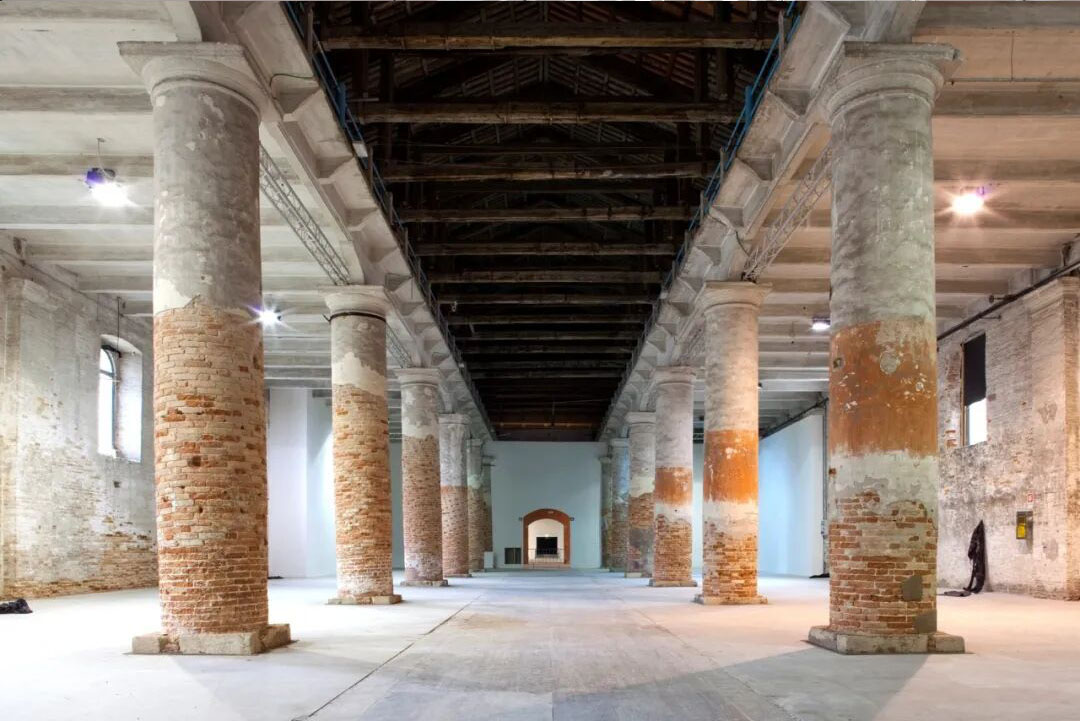
Corderie, photo by Giulio Squillacciotti
Venice Biennale on-site, 2026
Shadow Determines Attention
As May gives way to summer, the sun in Venice gradually grows more relentless. Shade becomes a form of infrastructure.
In the Giardini, century-old trees cast broad pools of shade. Between the national pavilions are lawns and benches: some people eat sandwiches beneath the trees; others slip off their shoes and leave them neatly beside the bench. Outside the Central Pavilion stands a remarkable work by Nigerian artist Otobong Nkanga. She has cladded the building's four portico columns in bricks, filling the gaps with living plants. Vines are slowly climbing upward, and by the time the exhibition closes in November, they are expected to cover the entire façade. The work's temporality unfolds over six months of continuous growth. Yet the amount of time people is willing to spend with it depends, to a surprising degree, on whether there is shade nearby.
Along the narrow lane connecting the Giardini and the Arsenale, American artist Melissa McGill presents Marea ("Tide"), an installation of nearly one hundred painted canvases suspended from clotheslines. Their colors and forms evoke the rippling surface of the Venetian lagoon as they sway in the breeze. The work speaks of rising sea levels and the gradual disappearance of Venice. But its emotional force depends just as much on the time of day and the quality of light. Under the harsh glare of midday, it can seem merely decorative; in the raking light of dusk, it becomes an elegy. Shade and the angle of sunlight are the work's invisible collaborators.
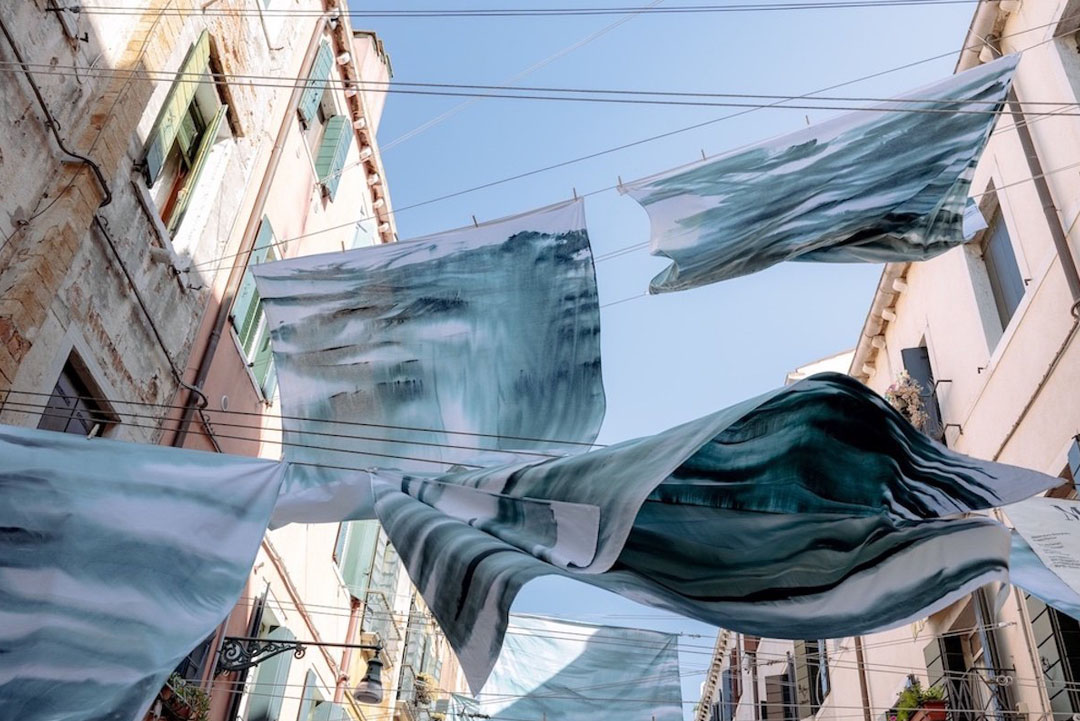
Marea, Melissa McGill, Venice Biennale on-site, 2026
This edition of the Biennale deliberately steps beyond the gallery walls, embracing outdoor installations, performance art, and poetry events. All of these depend on one simple condition: that visitors are willing to remain outside. In this sense, shade is a form of curation without attribution. It belongs to neither artist nor curator, yet it quietly determines the duration of public attention. A patch of shade may preserve a viewer's capacity for perception far more effectively than a monumental installation. Only when the body can truly pause can a work of art fully come into being.
Seating: Whether an Artwork Can Truly Be Seen
Seats matter, yet they rarely receive serious critical attention.
Many of this year's Biennale works depend entirely on the act of lingering. One of the most acclaimed pieces is Cauleen Smith's four-channel video installation, Wanda Coleman Songbook, and half of its success can be attributed to a very material decision: within the space enclosed by four monumental screens, the curatorial team placed two sofas draped with Turkish rugs. The sofas are not decorative; they are part of the work's operating conditions. Only by sitting down—enveloped in warmth and comfort—can Smith's images of Los Angeles seagulls, dog walkers, the Hollywood Hills, and the pages of Wanda Coleman's poetry begin to speak.
By contrast, Nick Cave's seven-part installation Two Points in Time—At Once unfolds along the long corridor of the Arsenale, tracing seven emotional stages of mourning and grief through bronze sculptures, flowers, antique serving trays, and embroidered self-portraits. It is a work that demands walking, but also one that asks viewers to pause from time to time. Yet the physical exhaustion imposed by the Arsenale made me realize that I had merely passed through its seven chapters, without truly entering any one of them. In this sense, a single chair can determine whether a work of art is merely consumed or genuinely experienced.
The Slovenian Pavilion, presented by the Nonument Group, brought the rubble of the previous Architecture Biennale into this year's exhibition. Broken bricks and construction debris from the dismantled exhibition became the floor beneath visitors' feet. We sat down there—simply because there was somewhere to sit. Watching Soundtrack for the Invisible House while seated amid the ruins felt unexpectedly restorative: a quiet antidote to the Biennale's habitual grandiosity and self-congratulation.
One of this year's official curatorial sections is explicitly titled "Rest." If that title is to be taken seriously, then the exhibition must fulfill its promise in material terms: enough places to sit, enough shelter from the elements, and enough space for the body to come to a genuine halt.
Here is the final section of your text, polished with the same balanced blend of novelistic observation, structural critique, and literary precision, keeping your paragraph structure completely intact.
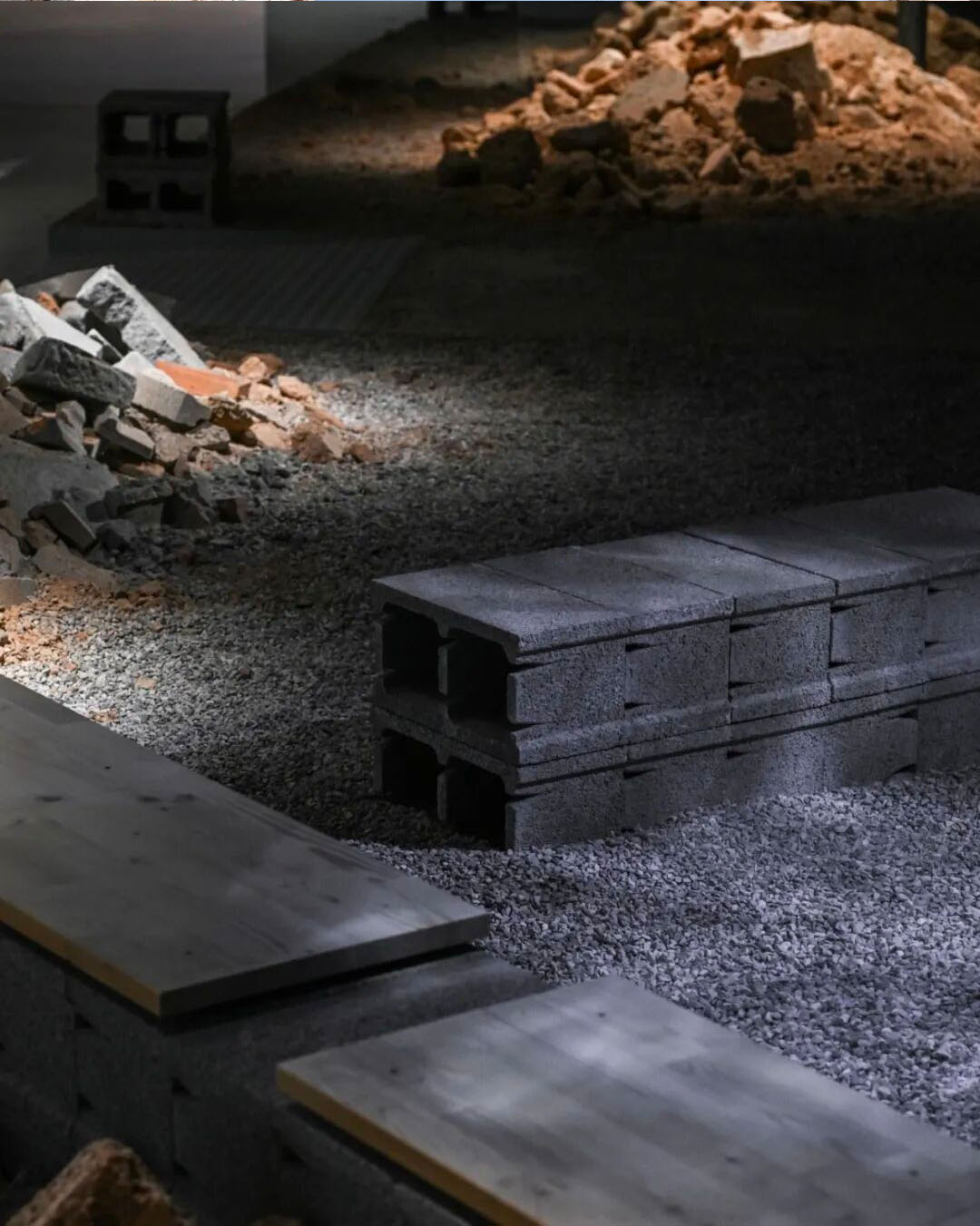
Soundtrack for an Invisible House, Nonument Group, Venice Biennale on-site, 2026
Sound: An Invisible Contest
The Biennale is also a complex system of sound. Audio leaks from video installations, live performances, conversations, footsteps, smartphone cameras, passing boats, staff instructions, and dozens of languages spoken simultaneously.
There was one revealing incident. On the first day of the preview, the Dutch Pavilion suffered a technical malfunction when its automatic shutters failed to open, leaving around sixty visitors locked inside. Unexpectedly, this became a welcome respite. Outside, the Giardini was overflowing with crowds; inside, the accidental enclosure offered a brief interval of calm. Sometimes a system that falls out of control comes closer to what people actually need than one that has been meticulously designed.
This year also marks the first participation of the pavilion from Timor-Leste in the Arsenale. Its exhibition explores how language is transmitted under colonial histories—through speech, through writing, and through entirely visual forms. Curiously, sounds from the neighboring pavilion leaked directly into the gallery space. Technically, this was a failure of acoustic isolation. Conceptually, however, those intruding voices perfectly embodied the exhibition's central proposition: language never exists in a vacuum. It is always enveloped by other voices, contaminated by them, and continually redefined through them. What began as an accidental sound leak became the work's most honest annotation.
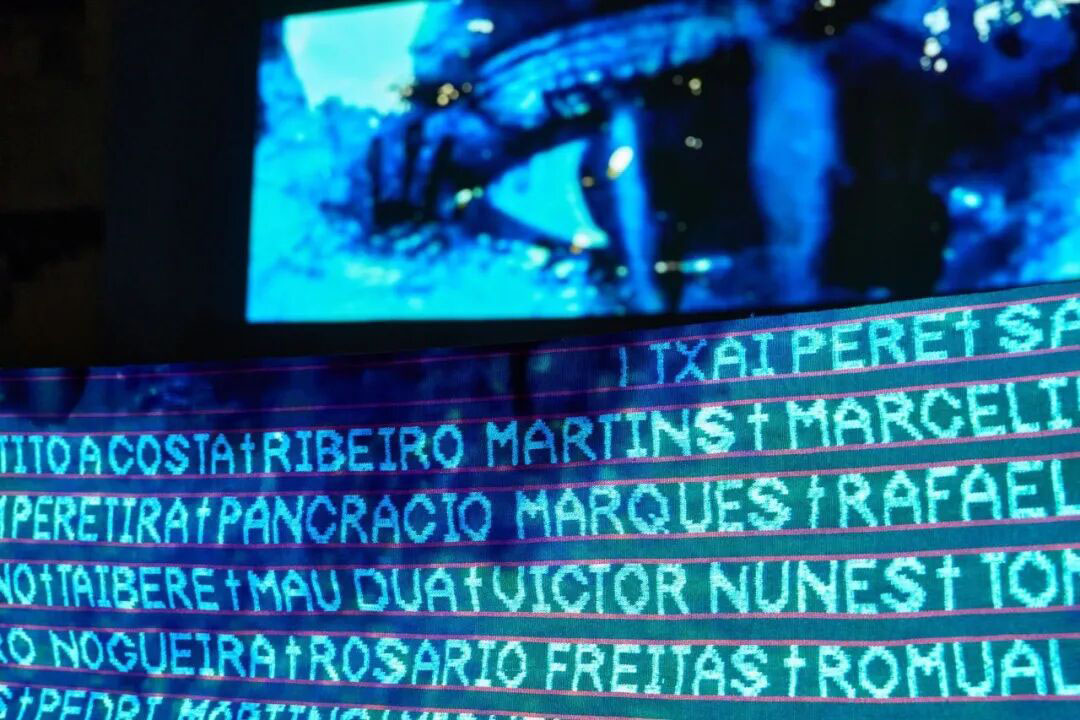
Venice Biennale on-site, 2026
Sound itself is unusually prominent throughout this year's Biennale. Kamaal Malak composed a synthesizer score for Maria Magdalena Campos-Pons's magnolia installation. Cauleen Smith's moving images unfold to the slow currents of jazz. And Torkwase Dyson's installation Tougaloo uses sound to construct an ecology of Black life and a geography of escape. Sound is the Biennale's most honest medium because it cannot be fully controlled. It has no clear boundaries and obeys no curatorial intentions; it simply belongs to the reality of the site itself. It reminds us that looking has never been a purely visual act.
Invisible Infrastructure: A New Question for Contemporary Exhibitions
We tend to think of the Biennale as an architecture constructed by artists, curators, national pavilions, juries, and critics. We debate works, themes, positions, and visual languages—arguing over which pavilion demands a visit, and which piece will endure in memory. But we rarely talk about the underlying realities: how long you had to wait to get in, how you traveled there, whether there was a breeze, whether there was anywhere to sit, what bled through the walls, or whether the body could simply find the strength to continue.
These elements—queues, waterways, shade, air, distance, seating, humidity, and sound—form the true infrastructure of the exhibition. They function as its invisible co-curators, establishing the underlying logic of the viewing experience itself.
The body arrives before the concept. In any exhibition, physical reality registers space long before the mind processes it. It determines how long we can stay, how much we can absorb, and what can genuinely move us. To ignore the body is to ignore the very conditions under which viewing takes place. Ultimately, the quality of these soft systems determines whether curatorial intent can actually be realized. Viewing is never just a detached act of perception; it is a fluid negotiation shaped by environment, time, fatigue, and desire. We simply rarely write it down.
At a broader level, this becomes a question of institutional equity. Those who can freely allocate time and physical endurance, returning to the venues again and again, inhabit an entirely different soft system than those who possess only a single day. Though occupying the same geography, they are effectively seeing different exhibitions. Distance, cost, bodily stamina, and time operate as invisible filters, quietly deciding who sees what, whose viewing becomes whole, and whose remains merely a glimpse.
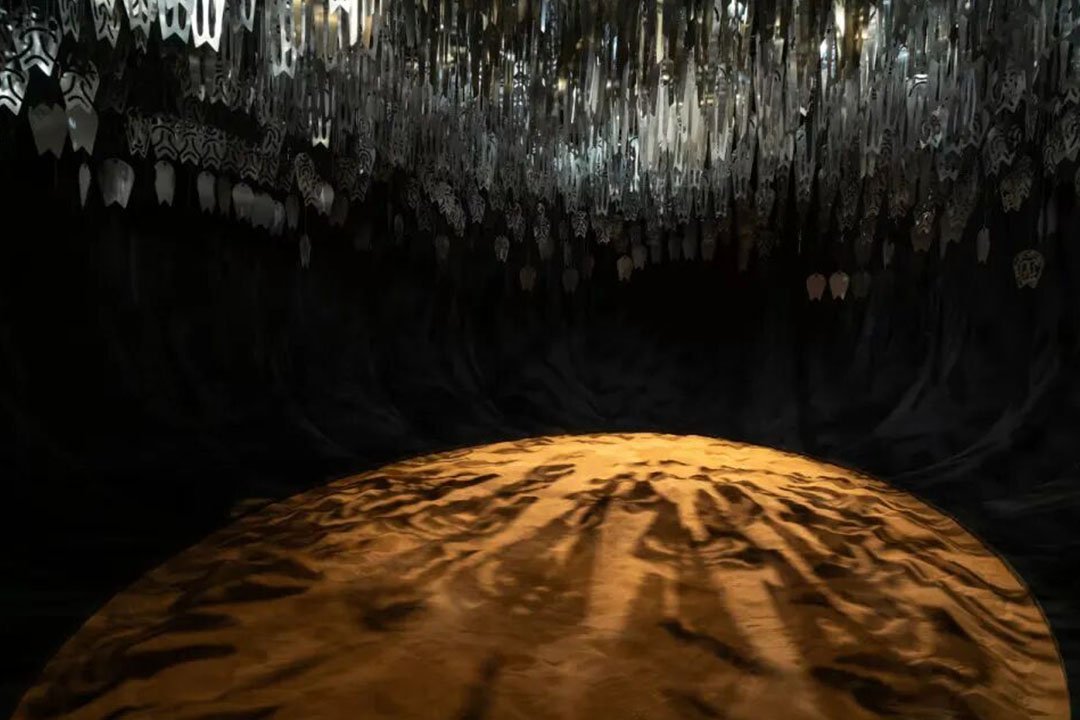
Oman Pavilion at the 2026 Venice Biennale, Venice Biennale on-site, 2026

Producer: Tiffany Liu
Editor: Tiffany Liu
Designer: Nina
Images: Xu Zhuojing's on-site photography and online sources



