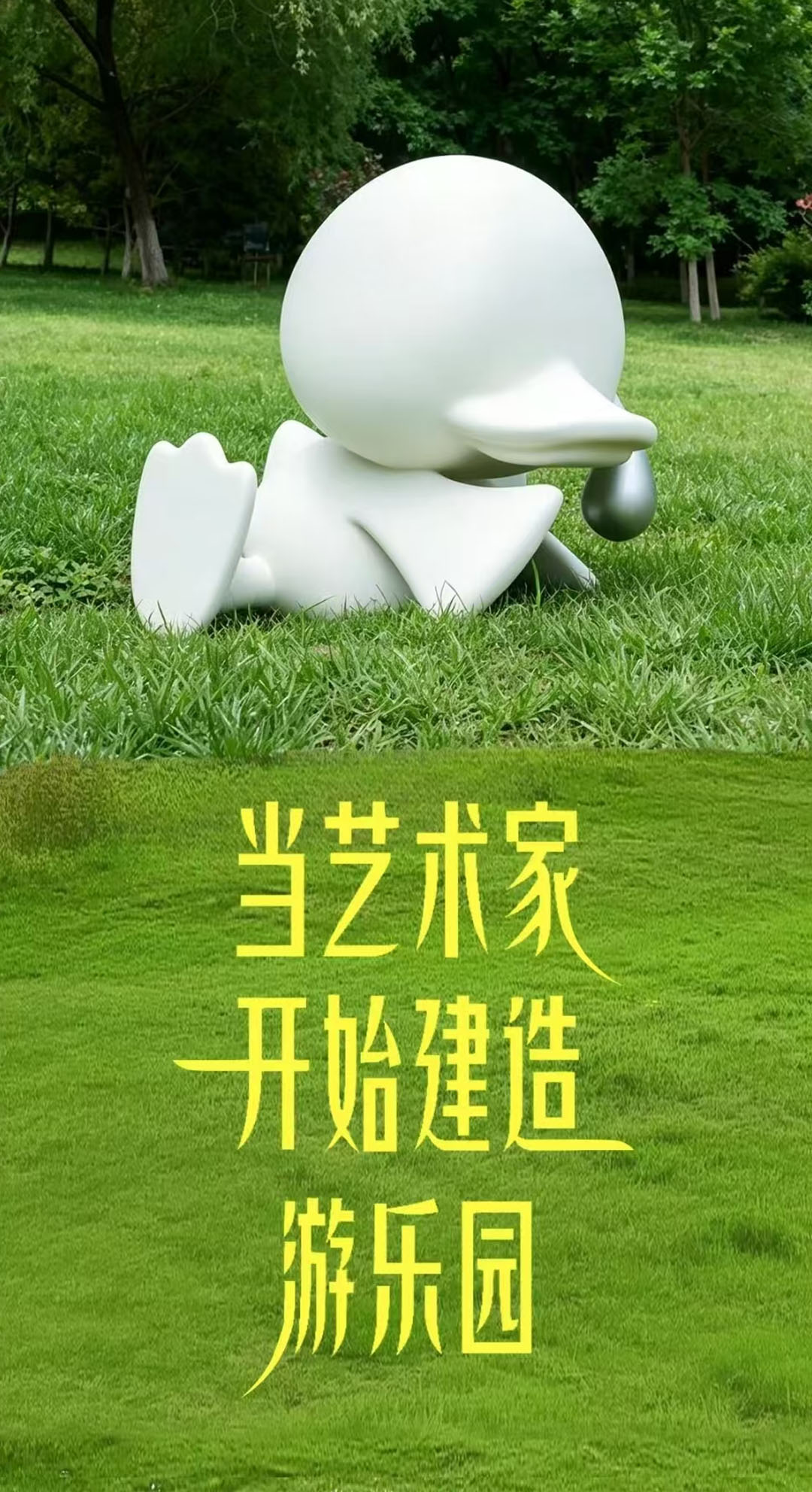
As the heatwave rolled in
The afternoon air rippled with haze.
A shriek from the amusement park far off cuts past your ear
No matter how many miles separate you
Or how many years
You will remember this moment,
Like stepping into a daydream
Amusement park, a temporary space that is set apart from the rules of the mundane, a place where we escape reality's constraints only to arrive, through that escape, at a deeper understanding of reality itself. “Play” itself defines the essence of “being human” and had played no less fundamental a role in artistic creation: beyond play in its simplest sense, the playfulness and experimentation it gives rise to have, at crucial junctures, driven the development of art forward.
This summer, Oui Art turns to contemporary art that takes the amusement park as its form and play as its inspiration, presenting the work of eight artists. Join us in wandering through their creations — a garden of the mind's own making.
Making Utopia
01 Carsten Höller
Since opening on July 14th, two glittering swing carousels have been rotating in opposite directions at an extremely slow speed in the galleries of UCCA Center for Contemporary Art in Beijing. Unlike amusement park rides built for speed, these have been deliberately stripped of their entertainment value: once seated, a rider must wait out a full rotation before being permitted to get off. The artist has no interest in replicating a fairground attraction within the museum's space; rather, his concern lies with the psychological shifts a person undergoes upon entering a system of rules — hesitation, anticipation, surprise, unpredictable bodily response. The momentary thrill of spinning is transformed into an experience of being "trapped" within a set of rules, forcing the rider instead to feel time's passage. What begins as an individual experience is at once converted into one with a social character. This becomes more concrete if we borrow Michael Fried's notion of theatricality: viewed from outside the work, the swing chairs function as a stage set, turning participants into performers; experienced from within, the visitor is at once performer and spectator.
Play is a recurring theme throughout Höller's practice, and one of the central threads running through this solo exhibition, "Two." When a visitor climbs inside "Dice (Chinese Marble)" and pokes their head out through one of the holes marking its "pips," the element of chance built into the game summons a bodily memory of childhood adventure. In "Beijing Dots," four color-shifting points of light track the visitor's movements, staging a recurring game of reward and punishment. And the play continues even after the museum closes: "Two Roaming Beds (Grey)" invites visitors to spend the night within the exhibition space, "roaming" via mechanized beds through the depths of unconscious sleep — so that upon waking the next morning, they find traces left behind by their own dreaming...
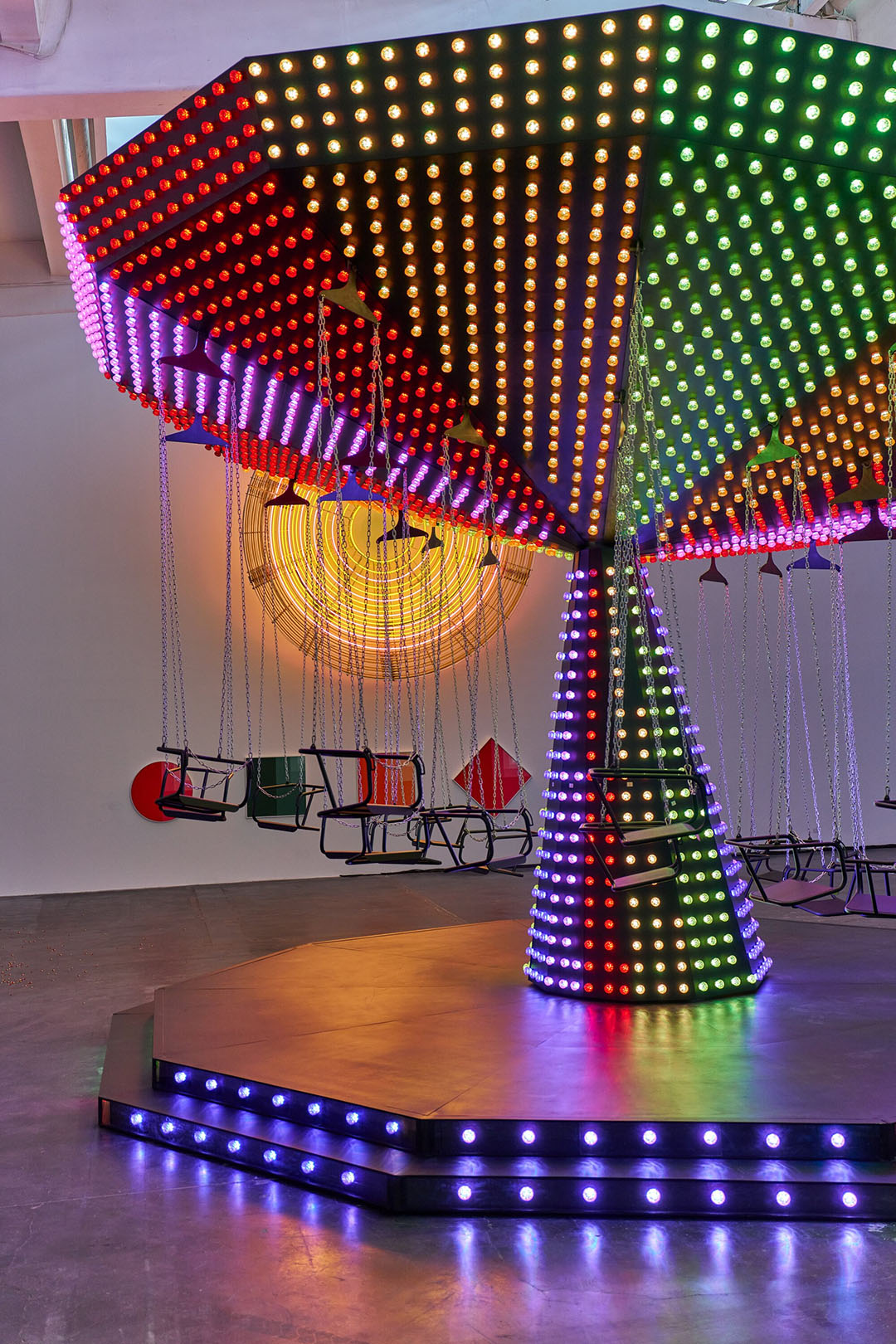
"Tilted Carousel (Five Colours)", Carsten Höller, 2026, installation view from "Carsten Höller: Two" at UCCA (Ullens Center for Contemporary Art), 2026, photo: Sun Shi, image courtesy of UCCA
02 Isamu Noguchi
Long before Carsten Höller brought amusement rides into the white cube of the museum, the sculptor Isamu Noguchi (1904–1988) had already taken on the role of a children's playground designer. In Atlanta, the playground he built, "Playscapes," is now marking its fiftieth anniversary. Set on an open lot within Piedmont Park, its colorful components of painted metal and concrete read less as play equipment than as a suite of spatial sculptures.
Noguchi's approach was revolutionary. Pushing back against the standardized playgrounds ubiquitous across America, he sought to answer a design question in sculptural terms: what is the best way to get children moving, thinking, and exploring the natural world? As children climb up and down, moving according to their own will, they are acquiring the capacity to comprehend the world around them through sensory experience. Noguchi's lifelong conviction that play is the way to reach one's own creativity finds its most direct expression in this playground.
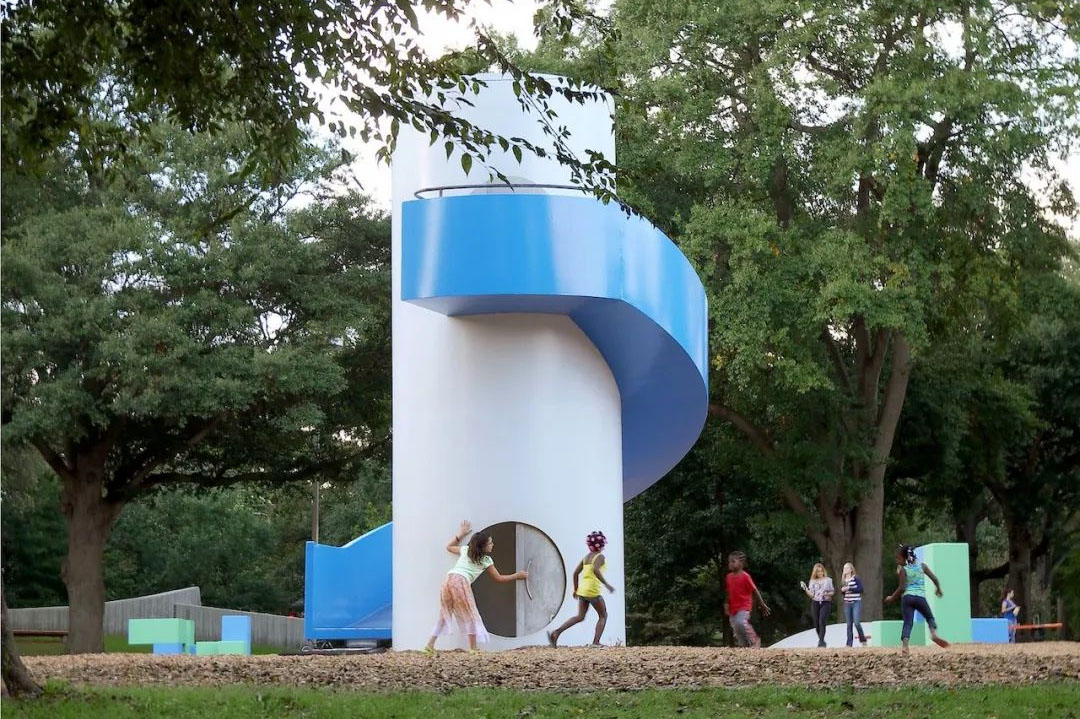
"Playscapes", Isamu Noguchi, 1975–76, image source: internet
"Playscapes" was the only playground Noguchi built in the United States during his lifetime — the culmination of an idea he had first conceived nearly three decades before. This past April, alongside the opening of his retrospective "I Am Not a Designer" at the High Museum of Art, the playground underwent a comprehensive restoration. The climbable cubes, the gracefully asymmetrical swings, and the spiraling cylindrical slide were all stripped of rust and repainted. Restored to its original condition, the playground remains as simple and enigmatic as when it was first built. Even by today's standards, it still feels remarkably forward-looking and captivating.
03 Niki de Saint Phalle
Several hours' drive from Rome, in Tuscany, the French-American artist Niki de Saint Phalle (1930–2002) left the world a garden of madness and magic — an Eden of her own making. Unlike Noguchi, who built his playground under official commission, Saint Phalle's garden began, in its earliest stages, as something closer to an unauthorized act of trespass on public land.
In 1979, the "monsters" began to rise up out of the Tuscan countryside — at first nothing more than enormous, contorted iron cages. Painted white, plaster laid over their metal skeletons, these monsters became towering, milky-pale phantoms. Eventually, they grew skin: blue, orange, pink, riotous mosaics, dazzling hand-painted patterns. Saint Phalle invited her friends — artists, sculptors, ceramicists — to the site, and the local villagers, who had once merely gossiped about or grumbled at "that madwoman and her monsters," began joining in as well, working alongside them. Twenty years passed this way, until twenty-two colossal sculptures drawn from the Major Arcana of the tarot stood complete, and the Tarot Garden was finished at last in 1998.
"I'm following a course that was chosen for me, following a pressing need to show that a woman can work on a monumental scale," the artist once wrote in a letter. Writing against an art history shaped by patriarchy, she meant to shatter the assumption that women could only make small, delicate sculptures, and to reclaim absolute sovereignty over the act of building. The monumental installation "Hon," which had once caused a sensation at Moderna Museet in Stockholm, found its afterlife here in the "Nana" sculptures scattered throughout the garden. The Tarot Garden was the work of Niki de Saint Phalle's lifetime — a place made for dreaming, and an undeniable monument in the history of feminism.
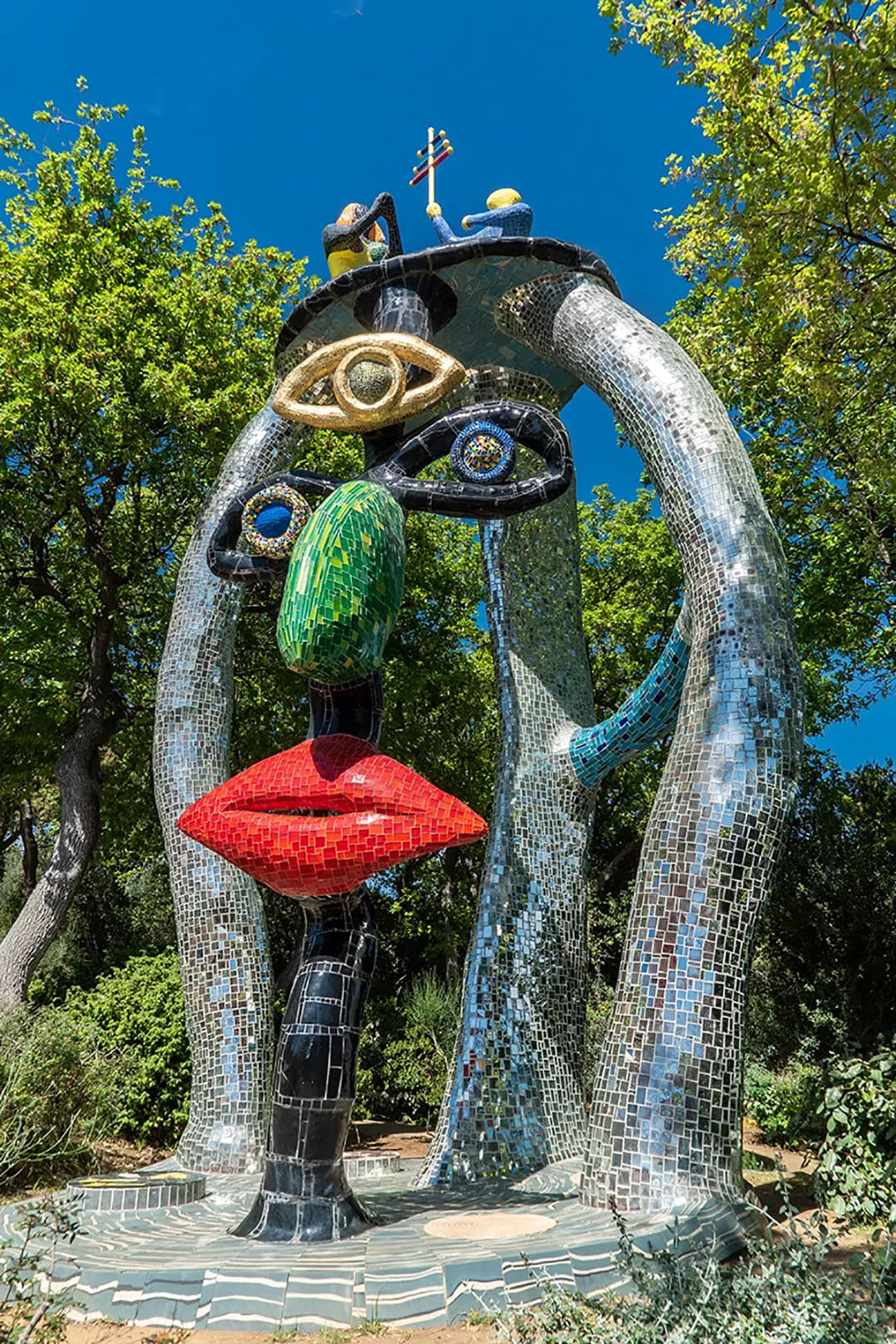
"Tarot Garden", Niki de Saint Phalle, 1979–1998, photographed 2023, photo and image courtesy of Clara Galanti
04 Luna Luna — by André Heller
Imagine gathering together some of the most creative artists of their generation and having them collaborate on a single amusement park. What might that look like? In 1987, the Viennese artist André Heller opened "Luna Luna" in Hamburg, Germany. Like most old-fashioned roadside attractions of its kind, the park featured iconic rides such as a carousel, a maze, and a Ferris wheel — pleasures for visitors of every age. In Heller's view, the museum was a niche space with a high barrier to entry, while the amusement park belonged to the public, to every child. Breaking down the class divide between elite art and popular culture, Heller's version of the amusement park was packed with works by celebrated artists — an astonishingly long list, including Jean-Michel Basquiat, Joseph Beuys, Salvador Dalí, Keith Haring, and David Hockney — thirty artists in total. That summer, roughly 250,000 people came to Luna Luna. Unfortunately, for a tangle of reasons, the park survived for less than a year before being sealed away in shipping containers.
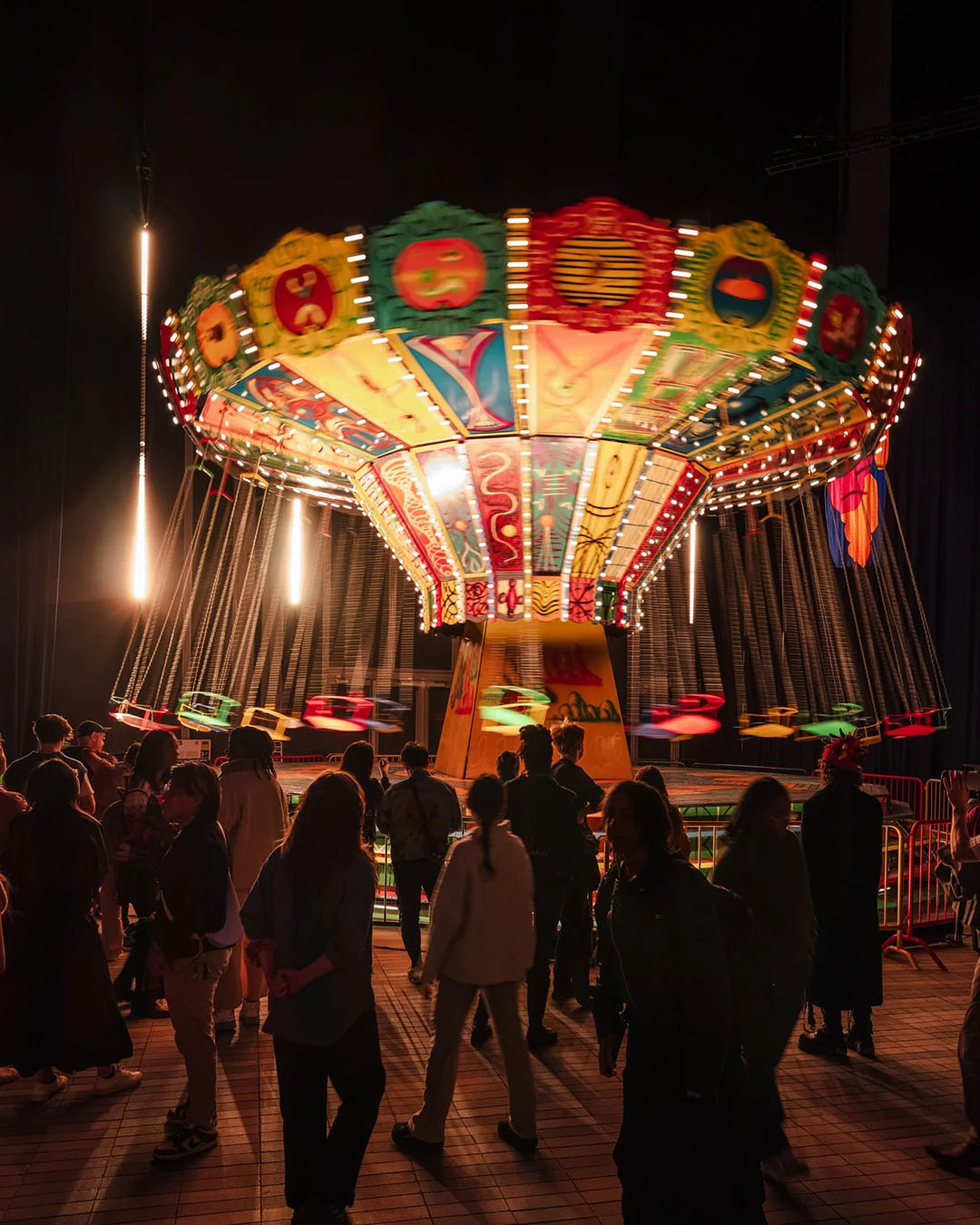
Hand-painted swing-chair amusement ride, André Heller, "Luna Luna: Forgotten Fantasy," New York, USA, 2024, image courtesy of Luna Luna
With $100 million in backing from the rapper Drake, Luna Luna was revived in 2024, launching a touring carnival across North America. The adventure continues — welcome to "the world's first art amusement park."
Playground Without Walls
05 Huidi Xiang
The French philosopher Jean Baudrillard once wrote, in "Simulacra and Simulation," that Disneyland exists to make us believe the rest of America is real, when in fact it is Disneyland itself that is real, and all of America surrounding it that has become the simulation. Within this theoretical framework, the amusement park is not merely a fictional America, but the real America — a microcosm of a "hyperreal" society constructed entirely out of signs.
Huidi Xiang, an artist who lives and works in New York, often builds her practice around early, classic Disney animation, translating the characters and scenarios of these films into installations and sculptures within a contemporary art context, in an attempt to unpack the invisible labor, pop culture, and social systems hidden beneath the surface of "innocence."
Her 2024 commissioned sculpture "at last, it has found its friend" dismantles, frame by frame, scenes from "The Ugly Duckling," probing the courage required to overcome obstacles on the path to self-discovery. Her 2024 solo exhibition project at Basel — titled "i made it." — drew inspiration from "Fantasia," presenting a magical scene mid-cleanup: a worn-out broom, exhausted from its labor, surrounded by scattered aluminum-cast, star-shaped cleaning effects. Within the artist's "miniature" amusement park, Disney animation scatters into signs rendered in a sculptural language both humorous and melancholic, casting one Baudrillardian question after another at the viewer: what is real, and what is fiction?
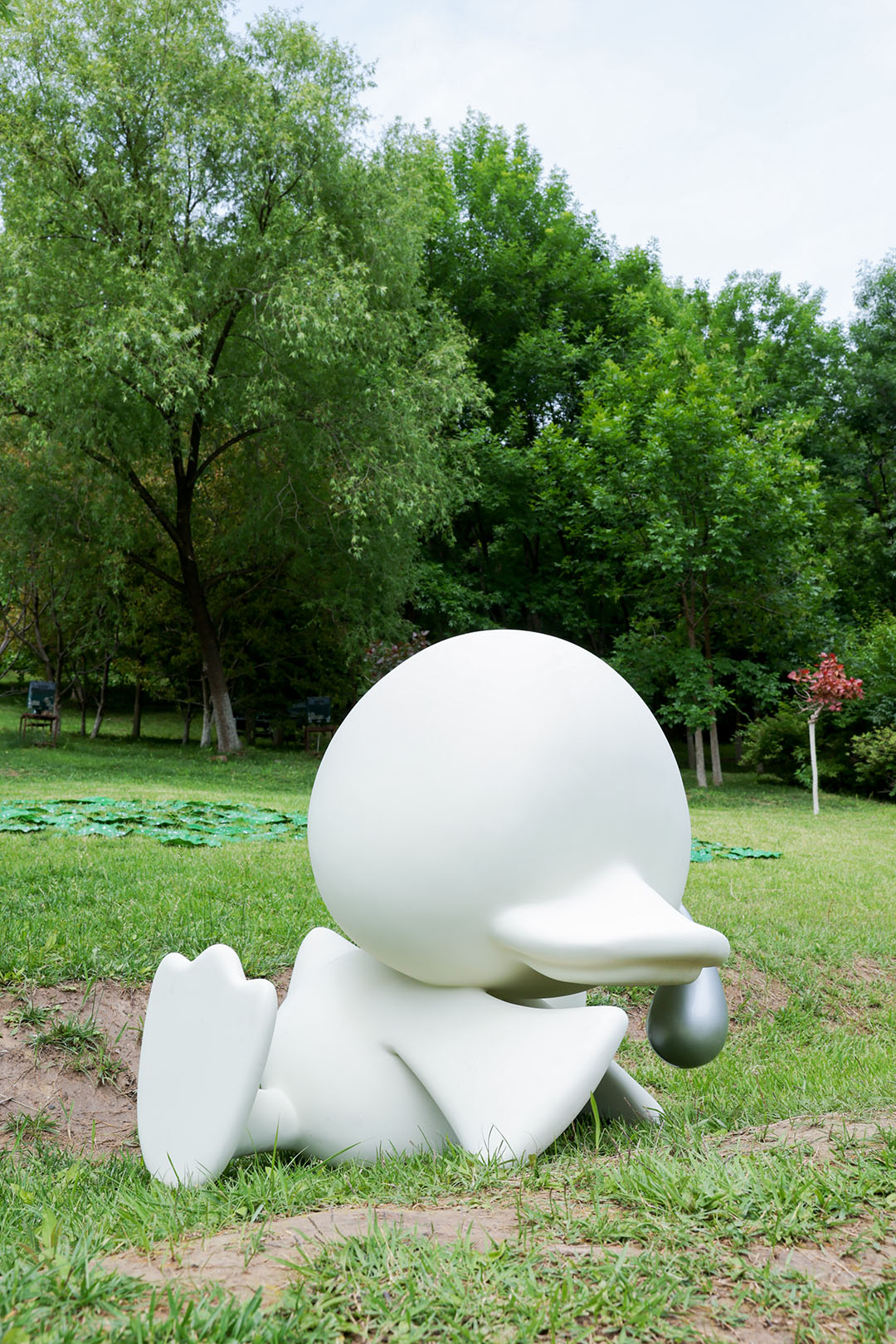
"at last, it has found its friend", Huidi Xiang, 2024, commissioned public sculpture for the 2024 Shanghai Jing'an International Sculpture Project, image courtesy of the artist and YveYANG Gallery
06 Leandro Erlich
Do you remember the first time you rode a pirate ship ride? Do you remember how you rose and fell with the seats, your eyes taking in the strange, magical angle of your surroundings? Fix your attention on what's directly in front of you, and depending on which "vehicle" carries you through the ride, you gain an entirely different way of seeing the world: accelerated, inverted, viewed from above, thoroughly warped.
Across many of his large-scale works, Leandro Erlich constructs a sense of surprise for his visitors not unlike this kind of fairground experience. But his creative motivation extends further than that — through visual shifts and dislocations, he pushes viewers to question and re-examine a reality they had long since taken for granted.
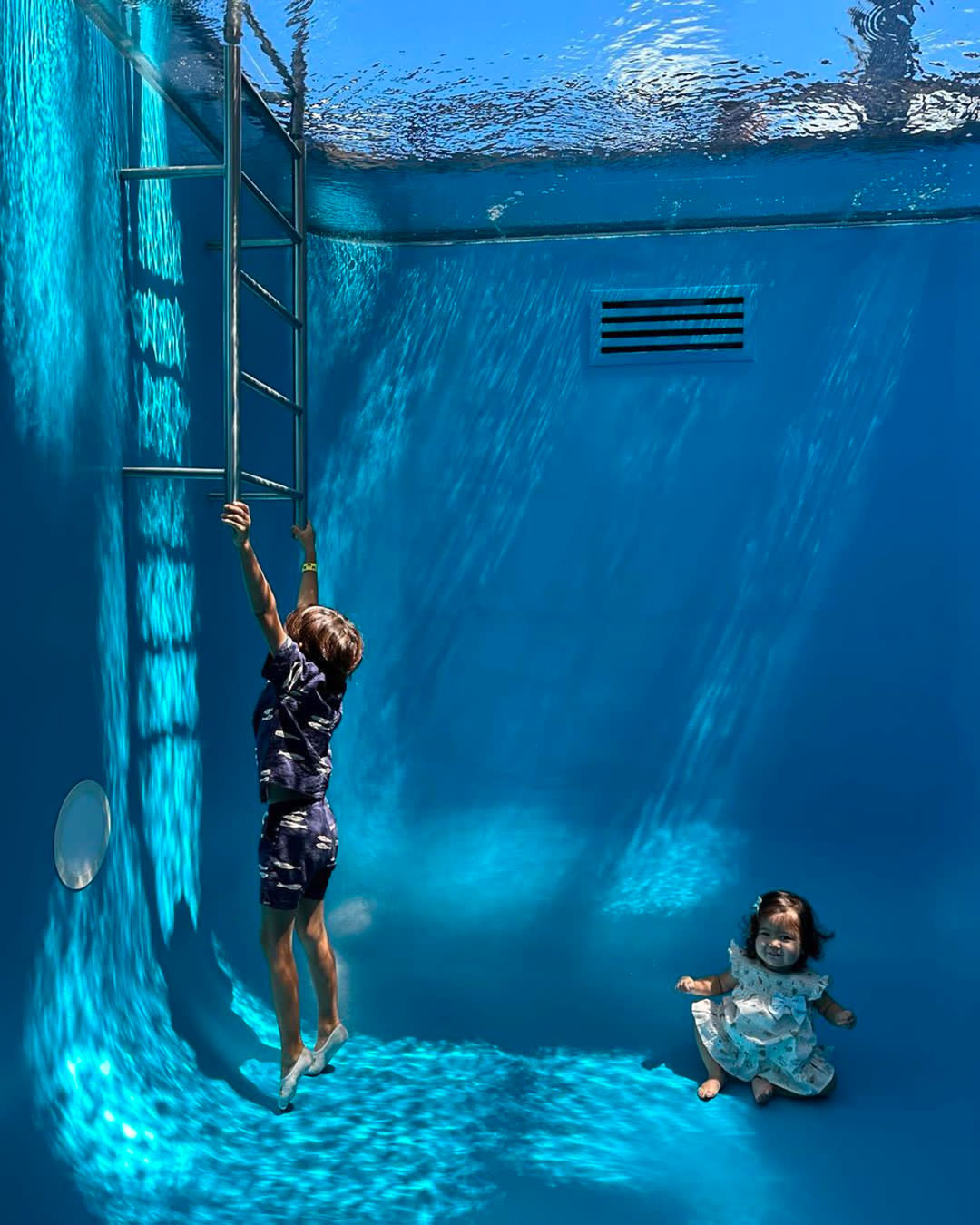
"The Swimming Pool", Leandro Erlich, 2006, 21st Century Museum of Contemporary Art, Kanazawa, 2024, photo and image courtesy of Ana Bonamico
"The Swimming Pool," now part of the collection and on view at the 21st Century Museum of Contemporary Art, Kanazawa, offers the magical sensation of walking underwater without a single drop touching you — an experience that instantly cemented this Argentine conceptual installation artist in the memory of Asian audiences. His 2004 work "Bâtiment" uses a mirror tilted at forty-five degrees to conjure the image of a crowd of people clinging to the facade of a Haussmann-style building. This summer, his eponymous solo exhibition is on view at the Grand Palais in Paris, featuring, alongside "Bâtiment," thirteen other monumental installations on-site. Suspended ships, weightless clouds, infinite labyrinths — the forms and contexts vary, but the underlying idea remains constant: to construct, at a scale appropriate to the human body, a space resembling the everyday world — one that, the moment you step inside it, reveals itself to be something else entirely.
07 Jessica Stockholder
A visit to an amusement park is always a journey: you move between different attractions scattered across the grounds, and between each stop lies the scenery and passage of the walk itself. Much like a journey, there is no single fixed vantage point from which to take in the whole of "Color Jam." As you move through it, perspective and color shift with you, and the "stations" along the way — streetlamps, storefronts, bus stops — become sites of your own choosing, determining the shape of your own experience.
Working primarily in painting-installation, Jessica Stockholder is committed to creating an experience grounded in form yet unmoored from any fixed choreography. The original impulse behind "Color Jam" was to send painting out into the "body," to set it free. Within this site where the artwork unfolds, every step a viewer takes becomes an improvisational act of bodily participation in a different facet of the painting.
Using more than seven thousand square meters of adhesive-backed vinyl sheeting and vinyl mesh fabric, she "poured" richly saturated blocks of color down the building facades at all four corners of a Chicago intersection, spilling them across the sidewalks and asphalt below. The work echoes, in its geometric form, the city's classic street-grid layout, even as its raw, exuberant, funfair-like sensibility stands in sharp contrast to that very grid. Passersby who wander through don't merely enjoy the pleasure of the scene shifting with every step — their own hurried figures, in the eyes of other viewers, become part of the artwork itself.
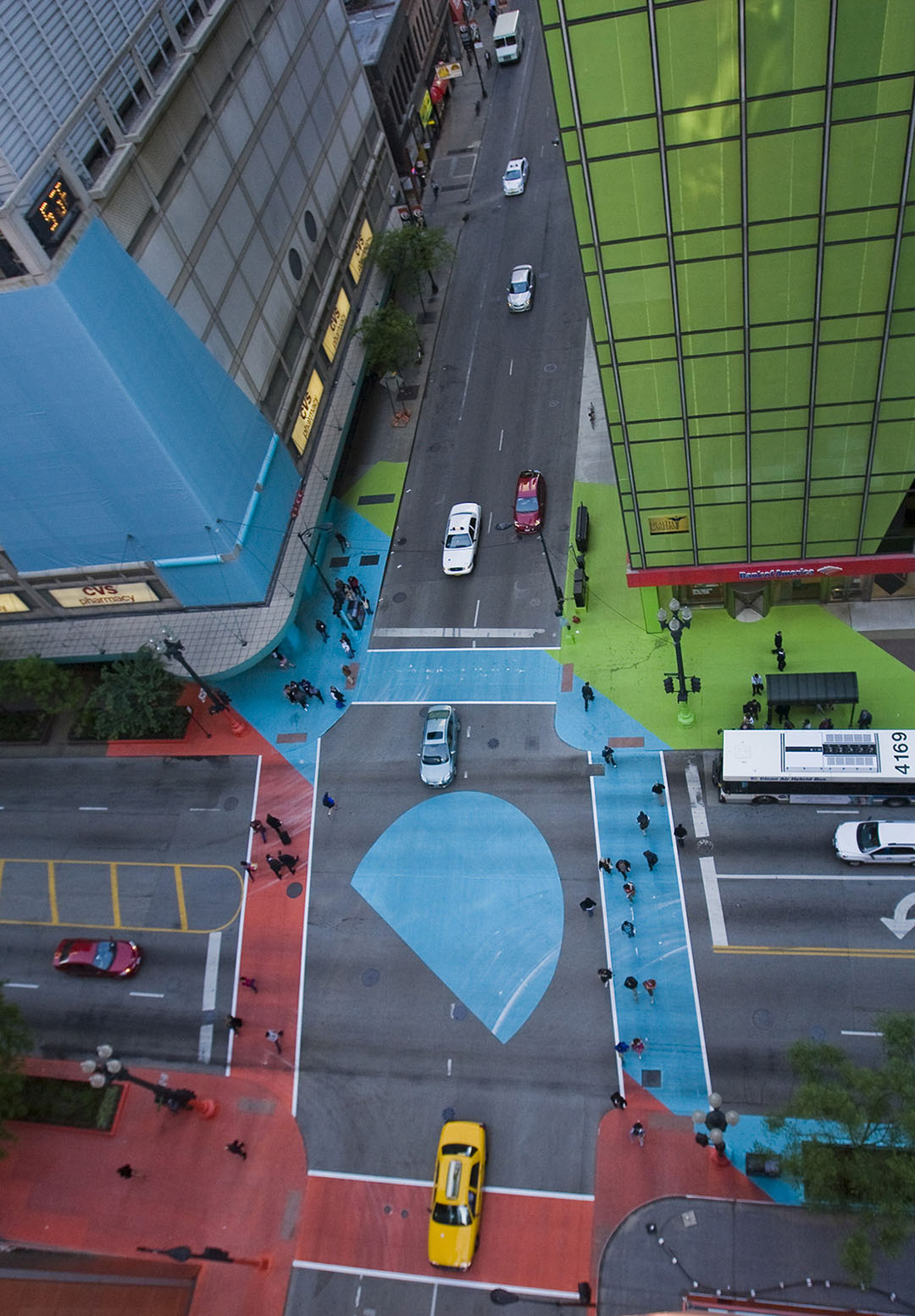
"Color Jam", Jessica Stockholder, 2012, intersection of State Street and Adams Street, Chicago, Illinois, USA, image courtesy of Jessica Stockholder
08 Slavs and Tatars
When it comes to artworks designed to be "played" with, a key question inevitably surfaces: must art choose between seriousness and playability? In other words, does the presence of laughter necessarily mean a work's depth is diminished?
In truth, the two are not opposed. A number of the works discussed above already demonstrate, to varying degrees, that metaphysical weight and a certain kind of pleasure can coexist. And "Molla Nasreddin the Antimodern," by the Berlin-based art collective Slavs and Tatars (founded in 2006), stands as a superb example of this balance between gravity and the lightness of a knowing smile.
Inspired by the familiar children's spring-rider, the artists retell an ancient Central Asian fable, one that stands as a metaphor for the modern predicament: hurtling forward at high speed while remaining, in truth, chaotic and directionless. In the legend, Molla Nasreddin (known to us as Effendi, or Nasreddin Hodja) rides his donkey down the road facing backward, toward its tail. When passersby mock him for riding the wrong way round, he replies that he has not mounted the donkey incorrectly — it is the donkey that is walking in the wrong direction. Slavs and Tatars lend this thirteenth-century Turkic sage a buoyant, playful color and leave room for his "playmates" — children who cling tightly to his somewhat rounded belly. This wise man, who carries within him a tangle of overlapping legends, moves forward in a resolutely antimodern way. Perhaps we are all like him, astride the donkey's back, forced to jolt and stumble along as the times march on.
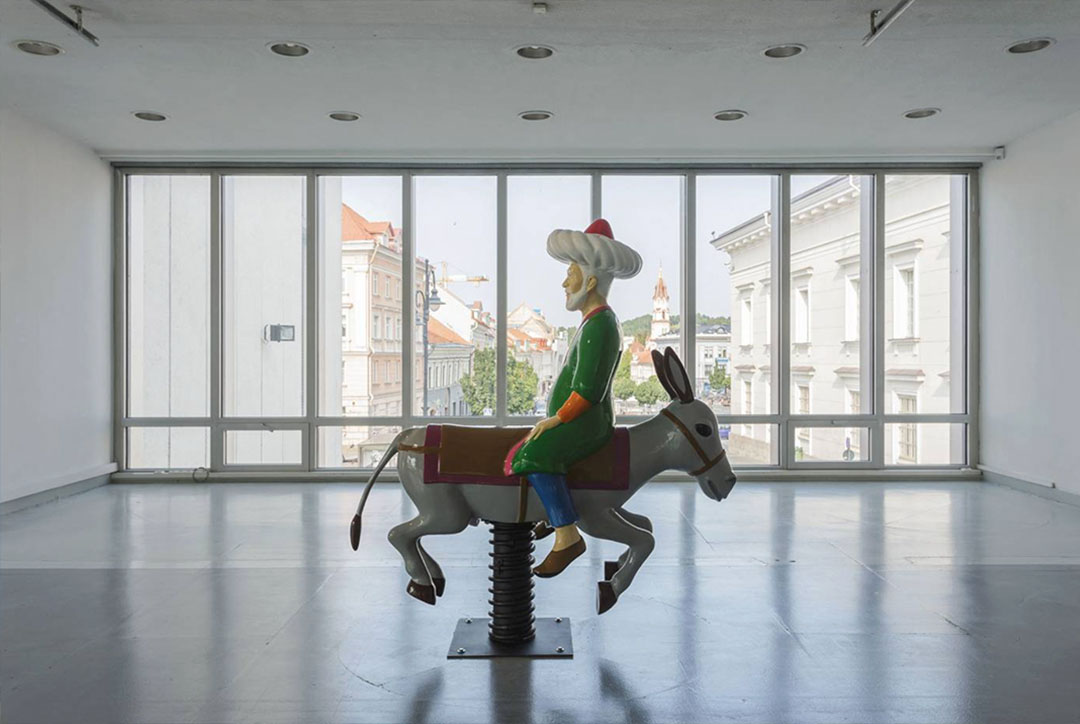
"Molla Nasreddin the antimodern", Slavs and Tatars, installation view from "Mouth to Mouth" at UCCA, 2017, image courtesy of Slavs and Tatars

Producer: Tiffany Liu
Editor: Tiffany Liu
Designer: Nina
Image: From the official website of the artist and gallery



